

Electrifying an American Pastime: The SEEA EV Rental Experience
A road-trip is a central piece of American culture, and for many of us, it brings back memories in the front and backseats. On a business or personal trip away from home, a car rental can often be part of the planning and logistics. Whether or not you already drive an electric vehicle (EV), it can feel intimidating to plan a trip with an unfamiliar car, especially an electric one. SEEA staff members Justin Brightharp and Amy Lovell set out with a mission to test out the joys and challenges of rental EVs on a drive from Atlanta, Georgia to Tuscaloosa, Alabama, for a site visit with our partners at the Croom Foundation and CivicCore Solutions to discuss our mutual project, the SEEDS initiative.
At the reservation stage, most of the major rental agencies now advertise electric vehicles as an option, but with a familiar caveat “or similar.” Though there can be important variations for gasoline-powered cars – the number of seats, luggage capacity, fuel economy, and comfort features – renting an unknown EV adds additional uncertainty. The range varies widely between EVs, and without knowing battery capacity, charging speed, or even which charging networks the car can access, route planning can’t be done in advance, and can add departure stress.
The rental counter experience was similar to picking up a gasoline car. The usual instruction to “return it full or pay a refueling fee” was still there, but a key detail appeared only in the fine print: we had to return the car with at least 70% charge or pay a $35 fee, plus another $35 if the car was below 10%. Perhaps more importantly, there was no orientation on how to activate or operate the car. The car turned out to be a Tesla Model 3, which is activated by a key card that needs to be strategically placed beneath the front of the center console. When Justin reached the car in the garage, it took 10 minutes and a quick Google search to learn that the credit‑card‑shaped key had to be placed in a very specific spot before the car would shift into drive. Due to a later departure, Justin was going to charge the car at his apartment since it offered five level 2 charging spaces as an amenity to residents and guests. When pulling into the charging space, he couldn’t find the Tesla adapter for level 2 chargers and had to call customer service. Unfortunately, the rental agency did not provide a Tesla adapter for level‑2 chargers, which immediately limited our charging options and affected how we planned the trip. Although the Tesla adapter wasn’t included in the rental, the rental agency provided a QR code at the rental counter to ChargeHub for access to a map for public fast charging.
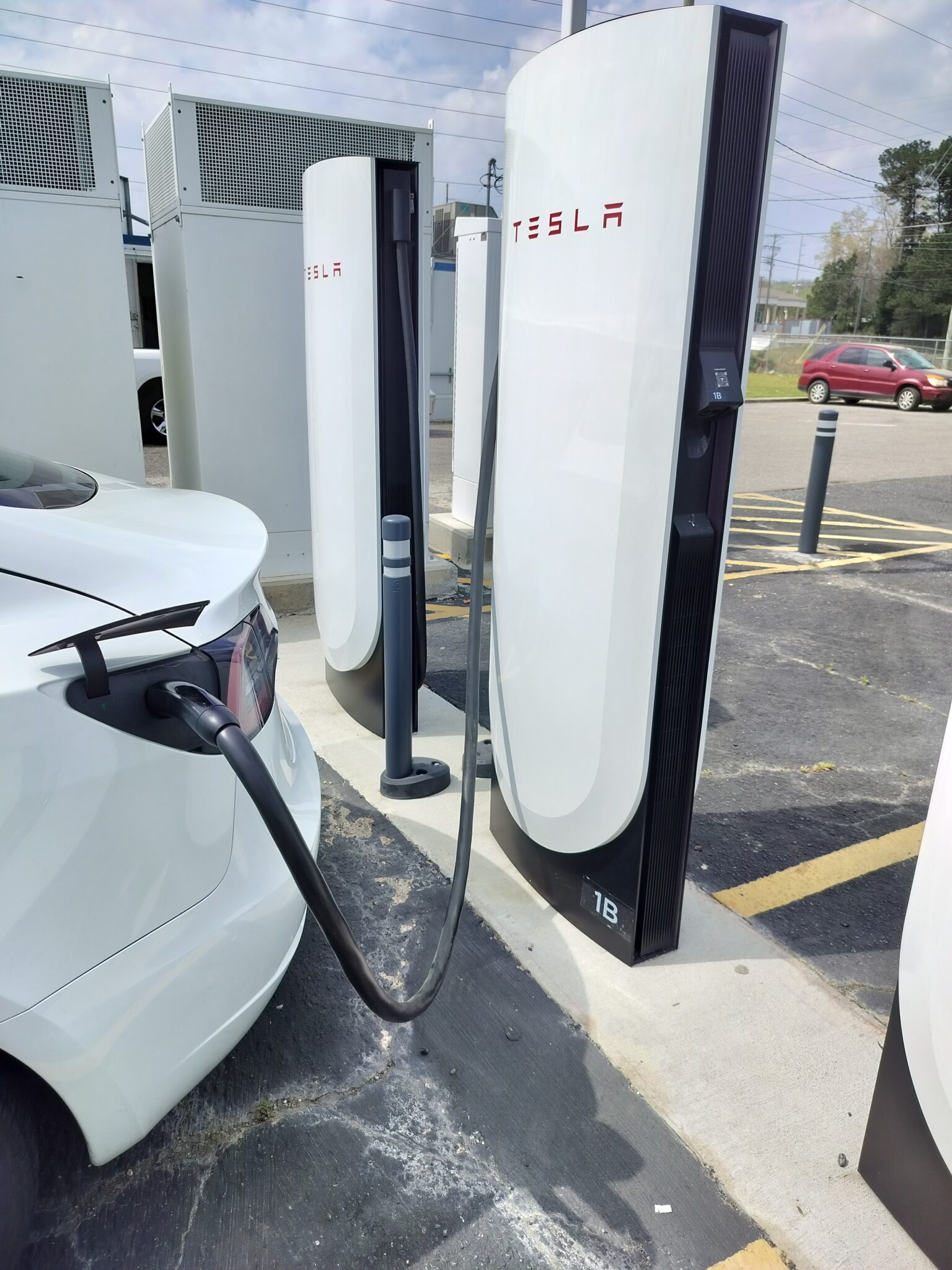
Without an adapter, we were limited to using only Tesla Superchargers, Tesla’s fast charging network. There were enough of them along our route, but at one location every plug was in use, which meant sharing power and waiting longer to reach our target charge level.
A full charging station means that the same power is being shared by more cars, so getting to the desired charge level takes longer and may add to the wait time. This is a form of managed charging where the power delivered is divided among vehicles based on battery capacity, e.g., a car at 20% will get more power than a car with 70%. Some DC fast chargers can deliver 150 kW, which could theoretically charge the entire 57.5 kWh battery in 23 minutes. More high-powered stations up to 600 kW are currently being developed, which will further reduce charging time.
One advantage of EVs with home charging options is that the car can charge overnight when the driver is safe and comfortable at home. This can be at a standard 110V home outlet (level 1) or with a dedicated 220V (level 2) charging port if the residence has one installed. The time to charge depends on the power available at the plug, with a standard value being about 6-7kW, though 11-12kW or more are possible depending on the local power infrastructure. Using the same battery example as above, even at the lower power, the car could fully charge in 8-9 hours. That means many EV drivers can plug in at home in the evening and wake up to a full battery by morning.
Some hotels and retail locations offer level 2 charging services for EV drivers, though not generally for free. The hotel where we stayed did not have charging infrastructure, though unless it had been a Tesla Destination facility, we would not have been able to use it anyway without the Tesla adapter. Other hotels in town did have level 2 charging, but at rates that were comparable to fast charging, or with additional per-session or per-hour charges that would have discouraged their use overnight anyway. We noted that several City of Tuscaloosa Level 2 charging facilities offered free charging. For this trip, driving a non‑Tesla EV without strong public fast‑charging access would have made planning more difficult.
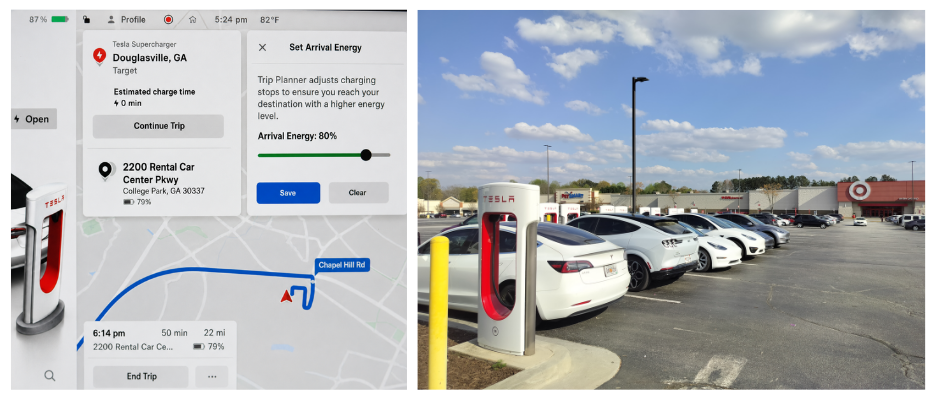
Trip planning was a multi-app experience, bouncing between PlugShare for availability and amenities, Google Maps for regional locations, and the car’s built‑in navigation for compatible fast chargers. Each tool had something to offer, but none was complete on its own, so we had to crosscheck information throughout the trip. Another limitation of the car’s navigation predicting the charging plan was that it would only suggest a single location, based on the selected arrival energy we wanted for our final destination (pictured), which we could change to get other suggested locations. There was the option to choose “best amenities”, and this option assisted us in stopping to charge while eating lunch on the return trip.
Charging a rented car raised additional questions in navigating a brand-specific infrastructure that assumes the driver is the owner of the vehicle. The rental agreement specified that if the rental car were a Tesla, fast charging would automatically charge back to the rental agency, who would add a “reasonable administrative fee.” We were left with specific questions: How high were those rental‑specific fees? Would charges show up right away, or later on the final bill? And while the Tesla App and the car’s built-in navigation would normally be an obvious solution to find and track charging, its limited compatibility with a rental situation, such as requiring a registration address, added another layer of complication. In the end, there were enough obscure fees and charges on the rental car receipt that we are not certain exactly which, if any, were added for refueling at the Superchargers!
Only mildly daunted by the situation described so far, we loaded up for the trip and were ready to depart Atlanta with 88% of the battery capacity. First, we needed to determine if we could get to our destination or if we’d need to stop to charge. After we selected our hotel in Tuscaloosa as the destination, the car’s navigation system selected a charging location near I-20 in a Wal-Mart parking lot in Pell City, AL. Even if the car had a full 250-mile range, we would have chosen to stop en route to charge, given the unfamiliar territory and limited charging options. We aimed to stop around 30% capacity, 120 miles into the 210-mile trip.
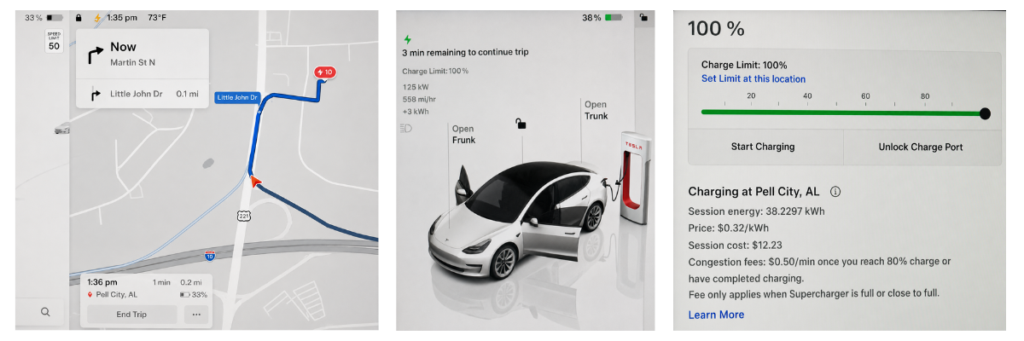
We arrived at the chargers in Pell City and found only two were occupied by other vehicles. At that point the car had 33% battery, so it only took 30 minutes to return to a full charge, adding 38.23 kWh at a cost of $12.23 ($0.32/kWh). At the beginning of the charging session, we observed instantaneous power at 125 kW, more than 10 times the power of most level 2 chargers!
We had enough battery capacity to drive around town while we were there, but stopped fairly soon into the return trip to top off in Vance, AL. We put in 36.93 kWh at a cost of $12.55, and while charging stopped for lunch at Sadie’s Diner off of I-20. It’s important to note that if we were able to charge at the hotel overnight, we could have made the return run with a single charging stop just before returning the vehicle.
After an additional stop in Douglasville, GA, before returning the car, to ensure we were at more than 70% per the rental agreement, total charging for the entire trip was $37.74, a total of 109.3 kWh of “fuel” for the car. The rates varied from $0.32/kWh to $0.38/kWh, though we were able to avoid the congestion fees of an additional $0.50/minute that may apply if all the chargers are full and the car is more than 80% charged (pictured).

Comparison to the alternative: An intermediate SUV at the same rental price was listed with 20-26 mpg fuel economy, since we were mostly on the highway, the 451-mile round trip would have required 17.3 gallons of gasoline, which would cost approximately $63.31. Our total cost for supercharging was $37: almost half the expense! To equal the cost of 8.2 cents/mile in a gasoline car would have required us to complete the trip using only 10.3 gallons of gas, an equivalent fuel economy of 44 mpg (very rare to find in a rental vehicle)! Compared to other electric or hybrid vehicles, going 451 miles on 109.3 kWh was an average of 4.1 miles driven for each kWh.
Downsides: Overnight charging was the biggest missed opportunity. With the right adapter, level‑2 chargers at hotels, homes, or retail locations could have handled most of the charging, particularly with an initial en route fast charge. Instead, the rental situation limited us to needing the faster (and potentially more expensive) options which were not as widely distributed, limiting our options and raising potential range anxiety.
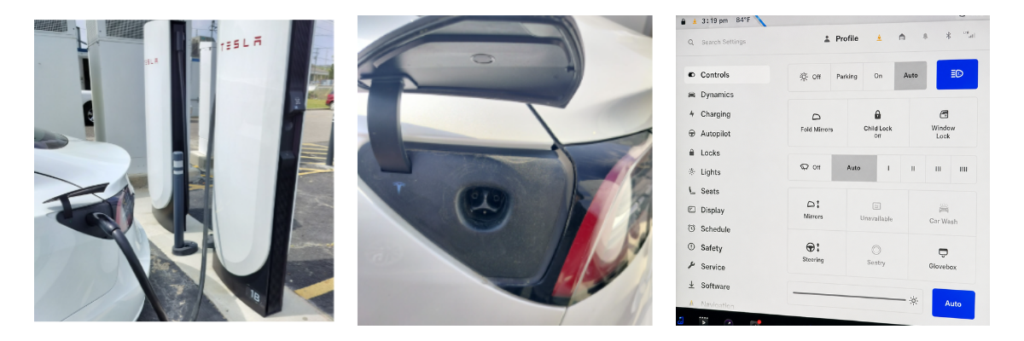
Other downsides included having to learn how to use an unfamiliar system which was primarily controlled on the screen, even for simple tasks like opening the glovebox or operating the windshield wipers or lights. The car eventually turned itself off when the key card was removed from proximity, but we felt more confident navigating the menu to turn it off manually. Depending on the site, the supercharger cable was not able to reach the charging port (pictured), which added some stress when there was only one charger available! While any rental car may have elements that are not familiar, there were certainly more unfamiliar and nonintuitive elements of the Tesla than a gasoline rental car.
So, would we take another road trip in a rented EV? With this experience under our belt and a better sense of how long fast charging takes, our answer is yes—especially if we know the car’s range and charging options ahead of time.
Several factors come into play when selecting an EV for a rental, including cost, charging availability, and safety while charging. For families weighing their next vehicle purchase, renting a car is a great way to decide which one is right for them. As road trips continue to remain a central part of American life, a fully supported EV rental experience can be an appealing option for consumers.