

Month: May 2026
May Map of the Month
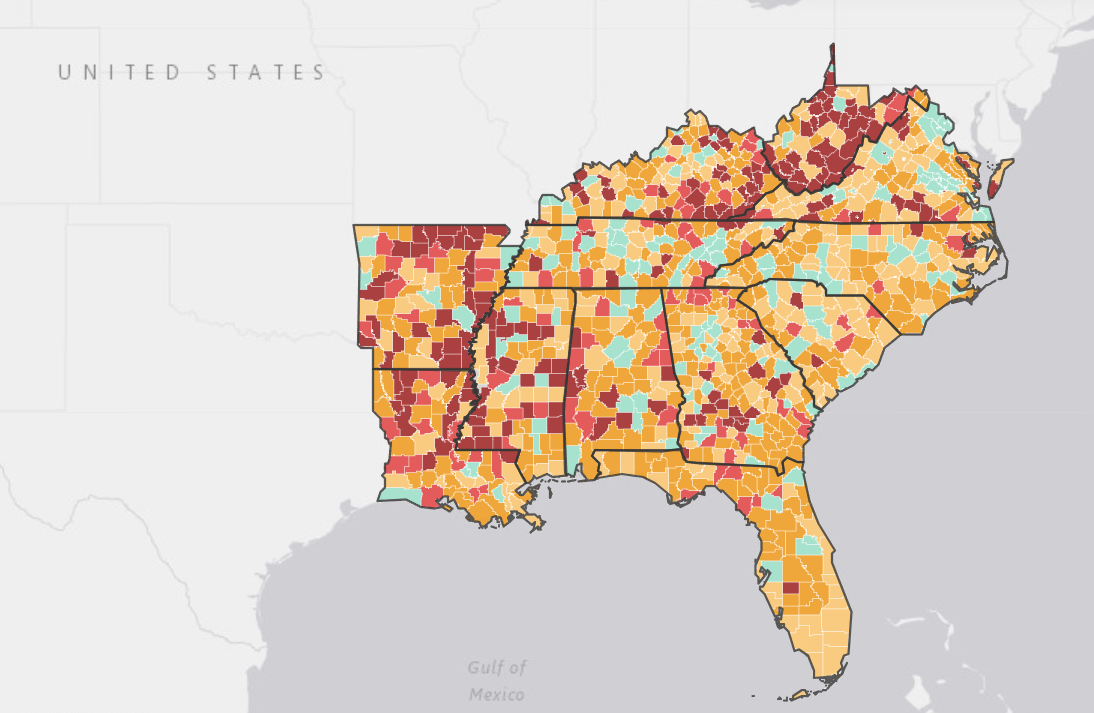
Where the contractors aren’t: mapping workforce deserts in the Southeast
By: William Bryan
Of all the barriers to scaling energy efficiency (and there are many), none are as fundamental as having people who can do the work. Yet throughout the Southeast, the workers who are essential to carrying out energy efficiency upgrades don’t exist in meaningful numbers, especially in communities where they are needed the most.
This month’s map makes this problem visible by mapping contractor deserts across the Southeast. Using data from the U.S. Department of Energy’s 2025 U.S. Energy and Employment Report (USEER) and the Census Bureau’s American Community Survey, we calculated the number of efficiency workers per 1,000 housing units for every county in the Southeast. To gauge how this workforce aligns with housing needs, we estimated local housing upgrade need by layering in data on the age of housing and household income.
Across the Southeast, there are roughly 429,000 upgrade-relevant workers who serve around 38.5 million homes, one worker for every 90 households. But this masks wide disparities in access to skilled workers throughout the region.
We found 190 counties across the Southeast that are in “crisis,” where high housing upgrade demand meets low workforce capacity. Even where they are not actively facing a labor crisis, more than half of all counties in the South are either at risk of becoming, or already are, workforce deserts. Across all desert and at-risk counties, the ratio is one worker for every 206 homes, with a ratio of one for every 411 homes in the most severely underserved counties.
Geographically, workforce deserts are concentrated in Appalachia and the Black Belt regions. “Crisis” counties are especially prevalent in eastern Kentucky and virtually all of West Virginia, where high rates of older housing and limited financial resources have contributed to a housing stock in need of upgrades. These are also communities without a contractor market robust enough to serve this need, a result of the lack of local projects, travel distances from larger markets, and low household incomes that cannot sustain significant projects. Kentucky leads the Southeast with 33 counties in crisis, followed by West Virginia with 32. Taken together, just these two states make up a third of all crisis counties in the Southeast.
The other major concentration of crisis areas runs throughout western Mississippi, northern Louisiana, rural Arkansas, and the Black Belt of Alabama. Like Appalachia, these communities have aging housing, deferred maintenance, and a contractor market that is insufficient to meet local upgrade needs. Louisiana’s Evangeline Parish, for instance, has around 20 home upgrade workers serving 14,500 homes, or one per 726 households.
In Dallas County, Alabama, just 80 workers serve nearly 19,000 housing units. This shortfall is especially stark given that 39% of all housing in Selma was destroyed by a major tornado in 2023. Despite initiatives from Alabama Department of Economic and Community Affairs (ADECA), the City of Selma, and the U.S. Department of Housing and Urban Development (HUD) to fund and support disaster recovery and home upgrades, these efforts require more workers than currently serve the community to meet the scale of need.
It is worth noting that our analysis likely understates the problem. The data we are using locates workers where their employers are based, not where they actually perform work, which means that rural communities surrounded by stronger retrofit markets in nearby cities may appear better served than they are. We crosschecked these findings with a dataset from the U.S. Census Bureau that tracks workforce mobility and found a consistent picture. In some states, this data showed that construction workers who live in rural areas regularly commute to urban markets where there is ready work and available capital, rather than serving their home communities.
The outlook for communities who face workforce shortages is not improving. The uneven programmatic and financing landscape for home upgrades may drive contractors to serve higher-income markets, while exacerbating deferred maintenance and expanding upgrade needs in the places least equipped to address them.
At the federal level, programs that have traditionally supported weatherization, retrofit financing, and workforce development – such as the Weatherization Assistance Program (WAP), the Energy Efficiency Home Improvement Tax Credit (25C), and the Training for Residential Energy Contractors (TREC) grants program – have been proposed for elimination or already cut.
Meanwhile, the construction workforce is aging, with almost 15% of the industry reaching retirement age in the next decade. This will place further stress on underserved and even adequately served areas if these workforce gaps are not filled.
We believe that these findings point to three conclusions for program designers, funders, and policymakers working to close the contractor gap in the Southeast and expand access to energy efficiency:
First, Appalachia and the Black Belt should be priority geographies for workforce development investments. Crisis counties in these areas have the most significant overlap between housing need and a lack of workforce capacity in the Southeast. They are least likely to be reached by market solutions or programs designed for communities with a more robust workforce, and they must be engaged on their own terms.
Second, retraining existing workers is a key short-term opportunity. When we used the broadest definition of the energy efficiency workforce (including all HVAC workers, not just those working on high-efficiency equipment), 99 counties looked adequate despite being contractor deserts when the focus was turned to upgrade-relevant workers. This suggests that these areas have contractors who are doing conventional HVAC work but could be trained to perform high-performance retrofits like heat pump installations.
Finally, closing workforce gaps requires a sustained, place-based strategy. SEEA has deep experience working on this through research, policy, and workforce development initiatives across the Southeast. At a local level, we have leveraged our research to work with municipal partners and community-based organizations on a range of workforce development initiatives. This includes working with the City of Selma, Alabama, and Southface Institute to train building officials, as well as a successful multi-year program to train underserved contractors in Georgia, with the Georgia Hispanic Construction Association (GHCA), Gwinnett Housing Corporation, and Lucky Shoals Community Association. At a regional level, SEEA has led multiple statewide studies of building activity and has provided education to building officials and contractors in seven states through our Building Energy Code Circuit Rider Program. Finally, we have also engaged new stakeholders to address workforce gaps through collaborative research and policy engagement through our Southeast Energy Insecurity Project (SEIP) and BRESE Collaborative.
These efforts have built critical workforce infrastructure throughout the South, but as our contractor desert maps show, there is still much work to be done. Mapping the problem is the first step. Connecting these maps to last-mile solutions is the work ahead.