

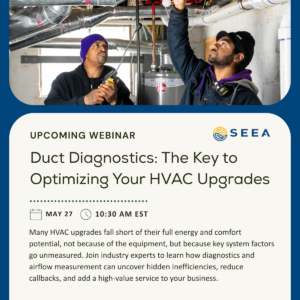
Duct Diagnostics: The Key to Optimizing Your HVAC Upgrades
Recorded on May 27, 2026
Many HVAC upgrades fail to deliver their full energy savings, comfort improvements, and system performance, not because of the equipment itself, but because critical system factors go unmeasured.
In this webinar, industry experts explore how diagnostics and airflow measurement can help contractors identify hidden inefficiencies, improve system performance, reduce callbacks, and provide greater value to customers.
Topics covered include:
• Advanced diagnostic and airflow measurement technologies
• Practical strategies for integrating measurement into everyday HVAC workflows
• Common performance issues that impact energy efficiency and comfort
• Financing approaches that can help make comprehensive upgrades more accessible to homeowners
Whether you’re an HVAC contractor, energy efficiency professional, program administrator, or industry stakeholder, this session provides actionable insights to help improve upgrade outcomes and customer satisfaction.
Map of the Month: Where are the contractors? Mapping energy efficiency workforce deserts across the South
Recorded on May 28, 2026
Across much of the Southeast, the energy efficiency contractor workforce is too limited to support meaningful home upgrades, even where demand is highest. In this webinar, SEEA introduces its Map of the Month series by exploring what contractor deserts are, where they exist, and what last-mile policy solutions look like for the communities most affected, with attendees getting first access to the May map and its findings.
Map of the Month: Transportation Costs and Burdens Across the Southeast
Recorded Jun 25, 2026
SEEA’s June Map of the Month uses data from the Center for Neighborhood Technology’s Housing and Transportation (H&T) Affordability Index to visualize transportation burden and annual vehicle miles traveled for moderate-income households across the Southeast. This analysis highlights where transportation costs place the greatest strain on household budgets, particularly in rural communities throughout the Appalachian Mountains, the Mississippi Delta, and the Black Belt.
In this recorded webinar, we explore where transportation burdens are highest, unpack the factors driving these trends, and discuss what these findings mean for communities working to improve mobility and affordability.
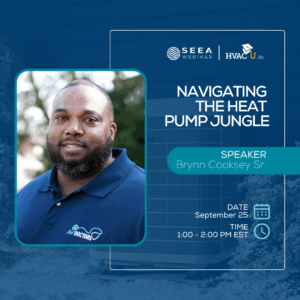
Navigating the Heat Pump Jungle
Recorded on September 25, 2025
Join the Southeast Energy Efficiency Alliance (SEEA) for an in-depth conversation on best practices for heat pump installations in cold climates. With incentives accelerating heat pump retrofits across the country, this webinar explores how thoughtful design and system selection can prevent costly missteps and ensure long-term comfort and efficiency.
Led by Brynn Cooksey Sr., a nationally recognized HVAC educator and owner of Air Doctors Heating and Cooling and HVAC U, this session covers the carbon-reduction rationale behind heat pump incentives, compares common system configurations, and shares proven strategies for successful cold climate installations.
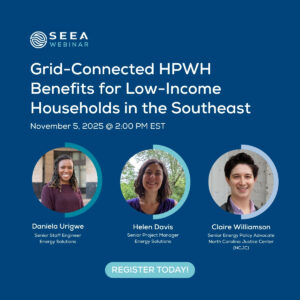
Grid-Connected HPWH Benefits for Low-Income Households in the Southeast
Recorded on November 5, 2025
The North Carolina Heat Pump Water Heater project investigates load shifting Heat Pump Water Heaters (HPWHs) installed in 24 low-income households in central North Carolina. Objectives for the project were to demonstrate that load shifting for HPWH is feasible and that it can create grid benefits without inconveniencing users. The project aims to increase deployment of HPWHs in the Southeast U.S., where the current high number of electric water heaters makes the transition technically easy with significant savings. The warmer climate also makes HPWH more attractive. The project analyzed short-interval electricity consumption data from 24 240-volt hybrid HPWHs equipped with EcoPort universal communication modules (UCMs) from the summer of 2023 through the summer of 2024. These EcoPort-equipped HPWHs were installed by Rebuilding Together of the Triangle (RTT), the local affiliate of Rebuilding Together. Participants received the HPWHs as part of RTT-provided retrofits and the EcoPort UCMs were installed in subsequent site visits in mid-2023. For about one week each month during the study year, the HPWHs operated without intervention to establish baseline, non-load-shifting daily patterns of water heater electricity consumption. The rest of the month the team sent demand response messaging to the water heaters, shifting electricity consumption from peak periods to off-peak periods during the day. The EcoPort-equipped controlled HPWH were able to significantly reduce water heating electricity costs for project participants. The study also demonstrated that demand responsive HPWH can avoid running during the annual winter grid peak period without customer intervention and without causing cold water incidents. Project findings suggest that seniors in low-occupancy homes with low hot water usage may be able to shift water heating electricity consumption more often and more reliably than other users, making seniors good targets for inclusion in demand response programs.
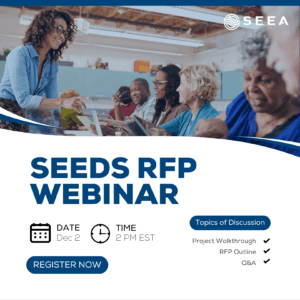
SEEDS RFP Webinar
Recorded December 2, 2025
SEEA issued our SEEDS Project Request for Proposal on November 10th. This webinar walks attendees through the project, RFP outline, and allowed applicants to ask any questions not addressed in the FAQ. For more information, please visit our website: https://annualreport.my.canva.site/seedsproject/.
Prioritizing Equity in Energy: Energy Insecurity Working Groups Kickoff
Recorded on March 27, 2024
Join the Southeast Energy Efficiency Alliance (SEEA) to learn about ongoing energy insecurity initiatives and opportunities to engage with a network of diverse professionals working towards reducing energy insecurity in the Southeast. Join us for the opportunity to be part of Phase Two of this project, the kickoff of working groups intended to revise, upgrade, and turn recommended solutions into actionable goals to reduce energy insecurity in the South. There are three possible working groups to engage with, those focused on Awareness and Community Engagement, Data Access and Improvement, and Utility Solutions. We are eager to engage experts or those with a keen interest in supporting solutions such as developing a user friendly one-stop shop.
Sharing the Benefits and Costs - Distributional Equity Analysis of Utility Investments
Recorded on December 13, 2023
In collaboration with E4theFuture, join us for an informative webinar on how to effectively analyze the equity implications of utility investments. In this engaging discussion, we will explore the differences between benefit-cost analysis and distributional equity analysis. Our panelists will share their insights and expertise on how to address equity in the benefit-cost analysis of energy efficiency and distributed energy resources. Discover how using these two analysis tools together provides a framework for a more comprehensive understanding of the impacts on all customers, fostering a fair and inclusive energy landscape.
Maximizing Impact and Equity with Innovative Policy Strategies
Recorded on December 8, 2023
Crack the code to transform federal, state, and local policies into tangible, equitable impact in this member-led webinar with ILLUME. In this insightful discussion, we will look at how to translate policy into action, balance competing priorities and explore strategies for maximizing positive outcomes. Join us as we navigate the complex landscape of policy translation, and provide you with valuable insights on harmonizing diverse priorities to create policies that are not only effective but also equitable.
Empowering Communities with Transportation Electrification Grants: Insights from Pacific Power’s eMobility Program
Recorded on November 8, 2023
Explore the potential to create lasting change through transportation electrification grants and discover how utilities can go beyond rebate programs to empower communities in this engaging webinar. Learn about the impact of grant programs on underserved areas, including BIPOC communities and rural regions and hear about real-world experiences from Pacific Power’s eMobility Grant Program in Oregon. Join us to gain insights into driving sustainable, community-driven transformation in transportation electrification.
Solutions to Reduce Energy Insecurity: Building a Better System
Recorded on June 29, 2023
In the final installment of our webinar series on energy insecurity, we’re joined by Nekesha Whitaker and Cole Thaler from the Atlanta Volunteer Lawyers Foundation and Bryan Cordell from the Sustainability Institute. They will share how they’ve overcome barriers to healthy and affordable housing like meeting pre-weatherization standards and the split incentive dilemma. Learn about their solutions for sustained change that reduce energy insecurity in Atlanta and South Carolina communities which have historically been excluded from energy efficiency upgrades ultimately leading to higher energy costs.
How to Leverage Data to Support an Equitable Energy Transition
Recorded on May 4, 2023
In the fourth webinar in our energy insecurity series to learn how to use data to reduce energy insecurity. Theresa Pinto and Abigail Fleming from the P.E.E.R. Group, a neighborhood law firm based in Miami, FL, discuss the need for access to data to support sustainable community development, equitable weatherization and an equitable energy transition. Additionally, Daniel Pate and Jerry Carey of NCSEA, demonstrate a dynamic, clean energy-related data hub that can help decisionmakers better understand the current state of the industry and benchmark sustainability performance.
How Utilities Can Invest in Solutions to Reduce Energy Insecurity
Recorded on April 12, 2023
The third webinar in our series exploring Stakeholder Recommendations for Reducing Energy Insecurity will highlight utility solutions to address energy insecurity in the Southeast. Lynda Powers, senior strategy and collaboration manager at Duke Power provided insights into program strategies like tariffed on-bill financing, and how the utility develops programs to work across their two-state jurisdiction. Shelley Robbins, project director at Clean Energy Group, shared observations on how Duke Energy includes customer demographics in their research techniques to design LMI programs and the importance of education and engagement in implementing programs to reduce energy insecurity.
How to Make Clean Energy Upgrades More Accessible to Renters
Recorded on March 15, 2023
Up next in our webinar series exploring Stakeholder Recommendations for Reducing Energy Insecurity, hear from Duanne Andrade, executive director at Solar Energy Loan Fund (SELF). We’ll discuss the work they’re doing with the Atlanta Housing Authority to tackle high energy burdens for low-income renters and overcome the standard split-incentive issue, where one party pays for the improvements and another party benefits. You’ll also hear about how to replicate their work with the support of incoming federal funding.
Promoting Knowledge and Engagement - Addressing Energy Insecurity in the Gullah Community
Recorded on January 25, 2023
In this edition of our series exploring the Stakeholder Recommendations for Reducing Energy Insecurity report we hear from Chriscilia Cox with Suma Consulting and Commissioner Marilyn Hemingway with the Gullah Geechee Chamber of Commerce. They discuss their work addressing energy insecurity by raising awareness and engaging residents in the Gullah community.

Who Pays and Who Benefits? How To Incorporate Equity in Utility Resource Planning
Recorded on December 13, 2022
Since 2017, the National Standard Practice Manual (NSPM) has provided a modern approach to benefit cost analysis for utility resource planning. It serves as the most comprehensive guide to transparently and consistently compare resources. In this webinar, you’ll learn about how the NSPM is considering the equity implications of resource choices – who pays and who benefits? Learn why addressing equity is more urgent now than ever before and how utilities in the Southeast are tackling this issue.
Southeast Utility Policy Highlights, July - September, 2022
Recorded on December 6, 2022
Join policy manager, Claudette Ayanaba, to hear state, local, and utility updates related to energy efficiency across the Southeast for July – September 2022. Updates include regional trends, energy efficiency programs, state and national legislation, rate cases, regulatory proceedings and more. Additionally, policy director, Cyrus Bhedwar takes a more in-depth look into the South Carolina Energy Freedom Act alongside current rate cases.
- Recording and slides coming soon
Southeast Energy Insecurity Project - Webinar Series Kickoff
Recorded on September 14, 2022
In early 2022, we assumed leadership of the Southeast Energy Insecurity Project, formerly known as the Southeast Energy Insecurity Stakeholder Initiative, led by the Nicholas Institute for Environmental Policy Solutions at Duke University. The initiative produced a report, Stakeholder Recommendations for Reducing Energy Insecurity in the Southeast United States, which includes 24 recommendations to address energy insecurity in the region.
On Wednesday, September 14, 2022 at 11 a.m. ET we held the first session in a series of webinars to further explore the project’s stakeholder recommendations.
Southeast Utility Policy Highlights, April - June 2022
Recorded on Wednesday, August 17, 2022
In an exclusive for SEEA members, join policy manager, Claudette Ayanaba, to hear state, local, and utility updates related to energy efficiency across the Southeast. Updates include regional trends, energy efficiency programs, state and national legislation, rate cases, regulatory proceedings and more.
Southeast Energy Insecurity Project Informational Session
Recorded on Tuesday, August 9, 2022
Learn more about our next steps in advancing the Southeast Energy Insecurity Project. We’ll briefly discuss the Project Implementation Award and Leadership Forum opportunities and answer questions.
The next step forward for affordable energy - Advancing the Southeast Energy Insecurity Initiative
Recorded on Monday, May 16, 2022
In 2021, SEEA joined over 60 partners in the Southeast Energy Insecurity Stakeholder Initiative. Together, we developed 24 recommendations to address energy insecurity in our region and are proud to announce that the final report is now available.
Going forward, SEEA will lead the initiative towards achieving our goal of ensuring that this stakeholder process leads to actionable progress on reducing household energy burden. Join us on Monday, May 16, for highlights from the final report, our vision for the future of the project, and the opportunity to answer questions and gather input.