
Month: July 2026
Extreme Heat, Unequal Risk: July Map of the Month
Heat is More Than a Weather Problem
The summer news stream is filled with tales of record temperatures, heat waves, heat domes, and the meteorological term El Niño has practically become a household word. While extreme heat has far-reaching consequences for ecosystems, energy demand, and infrastructure, a growing concern is its impact on human health.
Weather forecasts and newscasts often include advice about how to stay safe in the heat, but not every community experiences heat in the same way. The difference between a hot day and a public health emergency depends on many factors: a person’s age, pre-existing health conditions, and whether their home can keep them safely and affordably cool. This month’s map explores the connection between extreme heat and household health risks, highlighting communities where limited access to air conditioning heightens vulnerability.
CDC Heat & Health Index
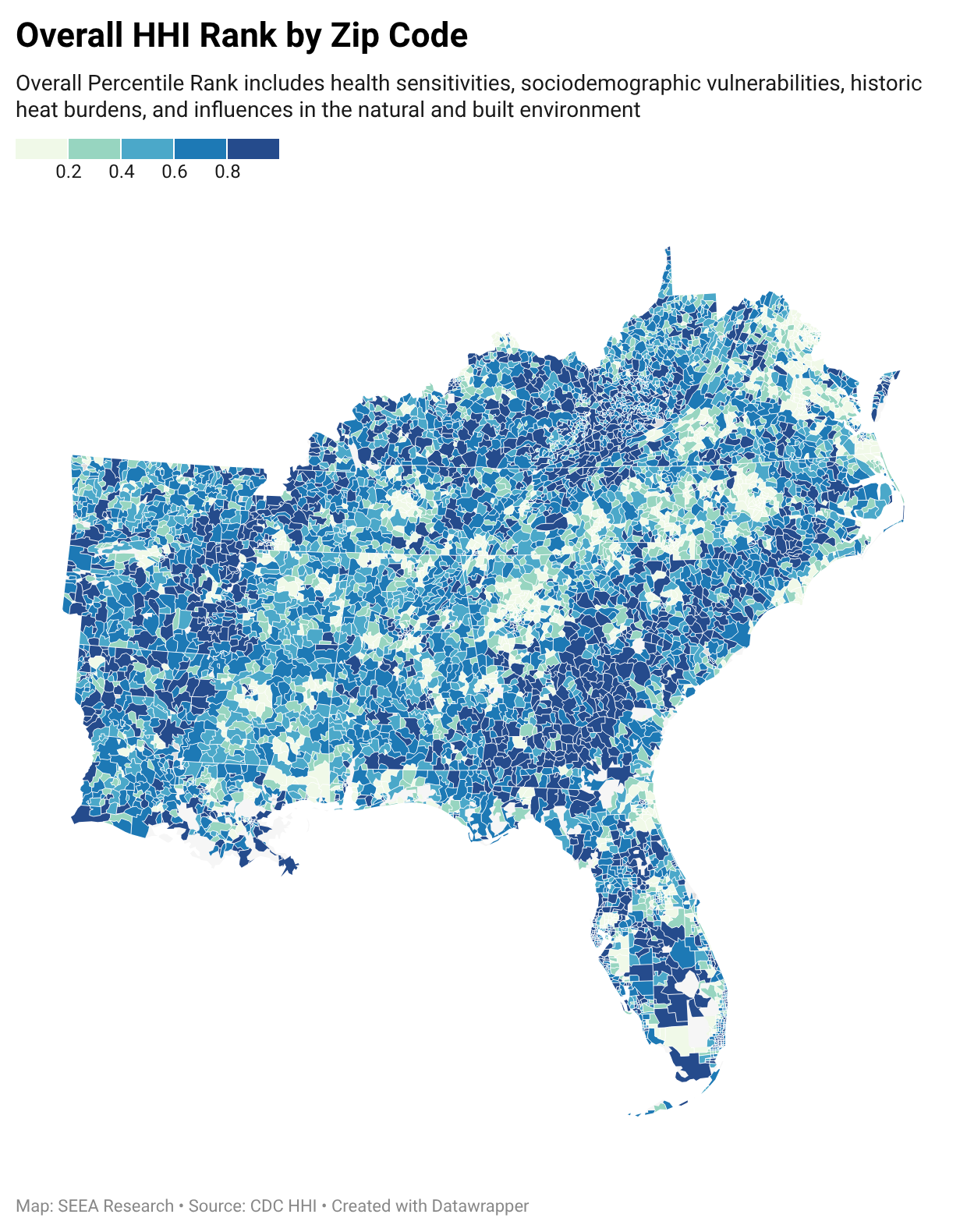
This month’s maps use the U.S. Centers for Disease Control and Prevention (CDC) Heat & Health Index (HHI), which combines historical temperature patterns, heat-related illness data, and community characteristics to identify where residents are most vulnerable to extreme heat (indicated by higher overall HHI ranking scores). In addition to the frequency of extreme heat days, the index factors in environmental features that influence heat exposure, such as tree canopy, air pollution, housing types, or access to transportation (HHI Natural and Built Environment). The index also includes demographic and socioeconomic conditions associated with increased vulnerability, such as age, disability, poverty, education levels, social isolation, and prolonged outdoor work (HHI Sociodemographic Vulnerability). The health conditions associated with greater sensitivity to heat include asthma, COPD, diabetes, obesity, cardiovascular disease, and poor mental health (HHI Health Sensitivities).
A few key patterns are evident in the HHI maps. Much of the Southeast scores high on measures of sociodemographic vulnerability and heat-sensitive health conditions. The maps highlight geographic disparities, including differences across rural and urban communities and regional hotspots where environmental factors like limited tree canopy, poor air quality, or transportation barriers may increase exposure to extreme heat. Like in any geographical analysis, localized risk factors are statistical: not everyone in a vulnerable community faces the same risk, and vulnerability certainly exists for some households in communities with lower HHI scores. Even with these limitations, the Heat & Health Index can help identify locations in need of interventions during extreme heat events, and can inform state and local resilience planning efforts.
One important consideration not shown in the HHI maps, however, is whether households have access to air conditioning to help protect residents from dangerous indoor heat.
Air Conditioning: More Critical Than Ever
Air conditioning is often the most immediate protection available when temperatures become dangerous. Most households, particularly in the South, depend on AC to maintain healthy indoor temperatures during summer, yet many do not have reliable or affordable access to air conditioning in their homes. Air conditioning uses significant energy to operate, contributing to higher household electricity costs and peak power demand in summer afternoons that stress the grid. Although many communities open air-conditioned cooling centers or public spaces during periods of extreme heat, heat risks are complicated for households who lack access to reliable transportation.
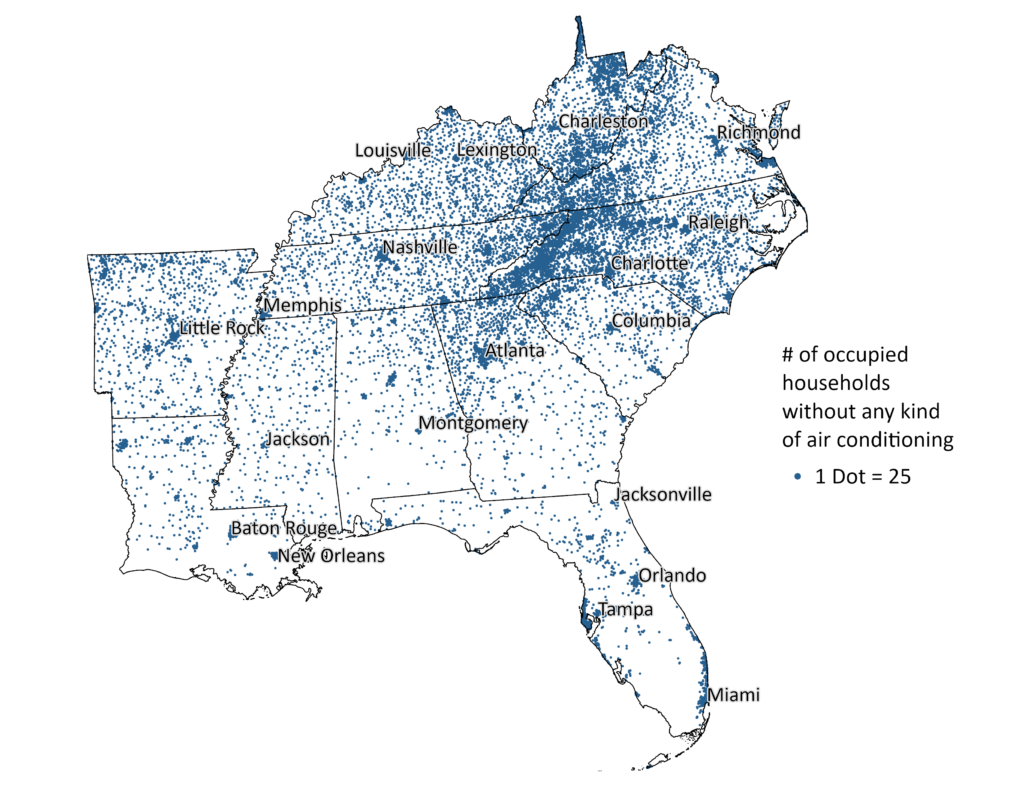
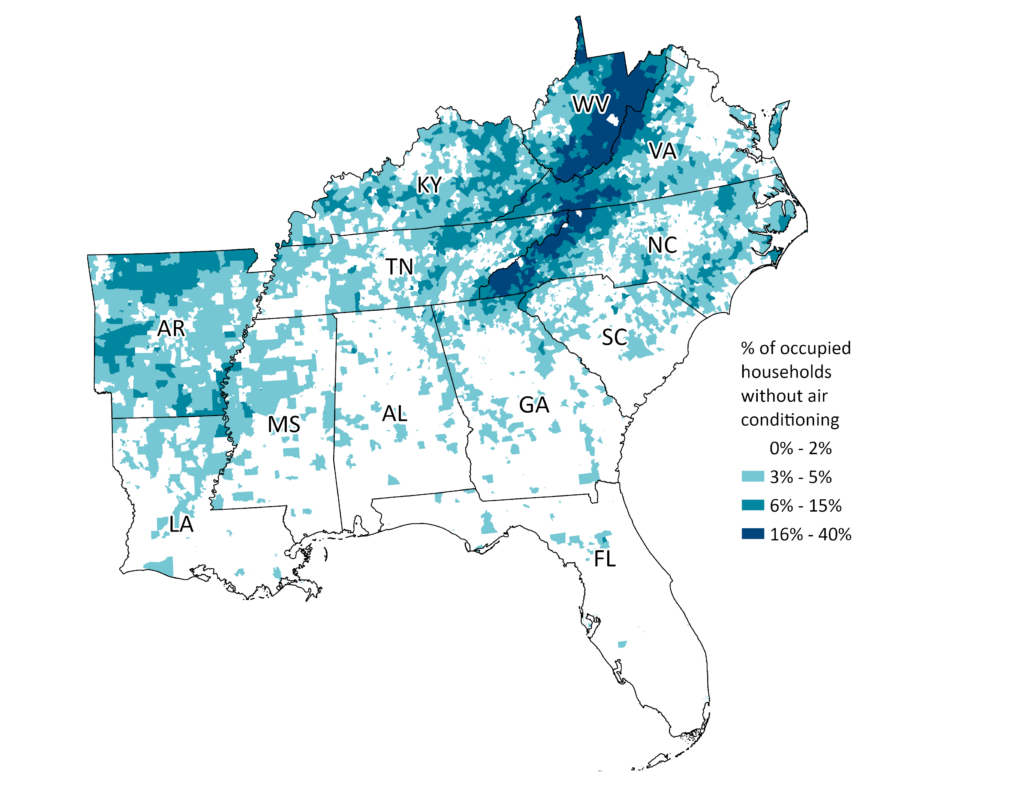
The U.S. Census Bureau has recently estimated the number of households nationally that lack air conditioning (AC). Although households in the South are more likely to have air conditioning than homes in some other regions, the data still reveal significant numbers of households in the region without any access to air conditioning.
The map below on the left shows one dot for every 25 households without AC, while the map on the right shows a shaded map for each zip code where 3% or more of the homes are not air conditioned. The Appalachian Mountains stand out, with between 16-40% of homes lacking air conditioning; however, many of these homes may be in cooler climate zones where other cooling strategies are still effective. Even in cooler regions, households without AC may be vulnerable during increasingly frequent and longer heat waves, while the number of households without air conditioning in Florida and the deep South, where high summer temperatures regularly top 90°F, highlights an additional layer of risk.
What Can We Do in the Southeast?
Heat resilience is both a household- and a community-level challenge, and it must be approached from both perspectives. Incorporating heat risks into resilience planning is more critical than ever. Communities can invest in immediate interventions like cooling centers and raise awareness of programs that assist residents with utility bills or protect households from disconnections during extreme events. Longer-term community strategies include updating new building energy codes and investing in tree canopy or other urban heat mitigation approaches. At the household level, a near-term solution that has long-lasting impacts is to invest in home weatherization and other energy efficiency improvements that help homes withstand heat more affordably. SEEA is exploring heat challenges through a 2026 partnership with the Lincoln Institute of Land Policy, examining how energy codes, building design, and other policy tools can strengthen household resilience to heat, particularly for vulnerable populations.
The growing intensity and duration of heat events have raised alarms for a reason: heat is a defining challenge across Southeast communities. The datasets illustrated here show the complexities of vulnerability, where health conditions, socioeconomic factors, environmental conditions, and access to cooling all play a role in risk during extreme heat events. Together, heat vulnerability data and cooling access models can help communities identify needed investments to keep homes safer, residents healthier, and indoor temperatures more livable across the Southeast. Whether through weatherization and repair programs, building energy codes, or resilience planning, well-informed investments can help protect the communities most vulnerable to extreme heat.
OpEd: The cheapest power plant in the Southeast is already built.
By John Silkey
My house was built in 1952 and renovated in 2021. New systems, new windows, new finishes (with a tired, generic farmhouse aesthetic – but that’s a story for another time.)
It still hemorrhages cold air in the summer and warm air in the winter. My energy bills show it every month. We did not skip maintenance – biannual HVAC tune ups, vent cleaning, weather stripping. A utility in home audit showed the house was meeting much of their standards with a few, expensive exceptions. The house still leaks.
The power company could build thirty more power plants. It would not fix what is wrong with my house. In fact, my bill would go up, because I would be paying for the construction of those plants and the fuel to run them, on top of the energy I am already wasting.
My house is not an outlier. Across the Southeast, roughly 40 percent of homes were built before 1980, before most of the region had any energy code at all. Conversely, despite our construction boom, less than 30% of southeastern homes were built after 2000. We have tens of millions of houses leaking energy every single day, in every single county, and every one of those leaks shows up as a charge on a customer’s bill and a megawatt added to a utility’s forecast.
I’m fortunate that I can financially handle this waste. Millions more in the Southeast are forced to decide between paying their power bill or their medical costs or their car payment.
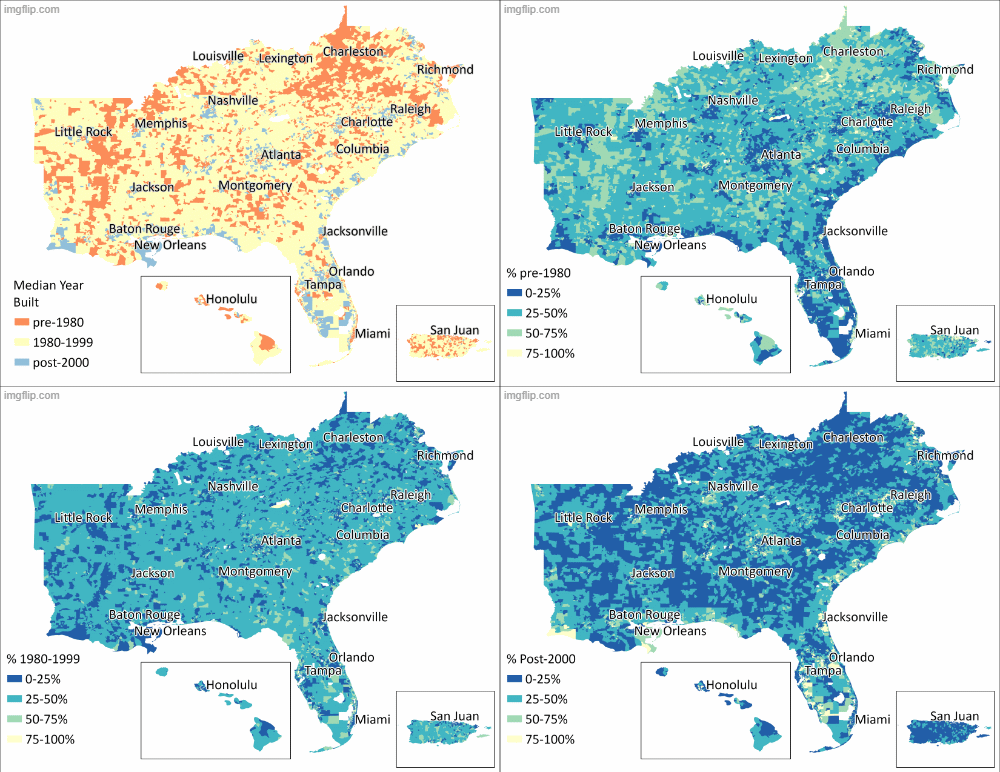
A map from SEEA illustrates the age of housing across the Southeast, including the percentage of homes built during different time periods and the median year of construction. The census tract-level analysis represents approximately 40 million homes across the region and is based on data from the U.S. Census Bureau’s 2023 American Community Survey (ACS).
For the first time since the 1970s, energy costs are back at the kitchen table conversation. Bills are rising. We have the fastest projected load growth the Southeast has seen in decades. And the response, from policymakers and much of the funding world alike, is to focus on what we can build. More generation. More transmission. More clean power before the tax credits disappear.
All of that is necessary. None of it fixes these homes and the massive drain of electrons spinning away underutilized. None of it changes the fact that we keep reaching for the expensive solution when a cheaper one is sitting right there, underfunded, in plain sight.
Here is the part of the equation that keeps getting left out.
Energy waste is not just an inconvenience. It is a cost driver, and the cost lands on everyone, not just the household with the drafty windows. When a building leaks energy, something has to make up for what it loses. That something is generation. Utility customers fund all of it. They pay to build the plants. They pay to fuel them. Every kilowatt wasted is a kilowatt that has to be generated, delivered, and billed, to every customer on the system, not just the one with the leak.
One kilowatt saved costs utilities less than $40 per year to deliver, according to ACEEE. One kilowatt of new generation costs more than $51 per year to build. A comprehensive efficiency upgrade, the kind my house still needs, can cut annual energy costs by 10 to 30 percent. Multiply that across 40 percent of the homes in the Southeast, and the math stops being about one homeowner’s bill. It becomes a regional capacity question, right as new power demand is pushing that capacity to its limit.
Some southeastern utilities already understand this. When they do long-term resource planning, projected efficiency savings come off the top of expected demand before they calculate how much new generation to build. They are not doing this to be good environmental citizens. They are doing it because it is cheaper than the alternative. A region full of homes like mine forces the grid to overbuild. A region of sealed, updated homes does not.
Meanwhile, federal lawmakers are cutting weatherization funding and LIHEAP, calling them government waste. They are not waste. They are investments that reduce the load every customer on the grid pays to serve. Cutting them does not save money. It defers the cost into the next rate case and hands the bill to the same customers these cuts claim to protect.
Clean generation funding is visible. A solar array is something you can photograph and point to at a board meeting. Efficiency is invisible by design. It is the energy that was never wasted, the plant that was never built, the bill that never arrived. Nobody cuts a ribbon for a sealed attic.
That invisibility is why it stays underfunded, and why philanthropy has a huge opportunity here.
Efficiency upgrades work faster and cheaper than almost anything else available, including solar, wind and battery. Demand-side resources can be deployed in under six months. A new gas peaker plant takes five to seven years to permit and build. Community solar takes at least 2-3 years. The Southeast does not have years to wait. The need for more power is growing now, and so are the bills of every homeowner whose house was built before anyone thought to ask how much energy it would waste.
Funding new generation without funding efficiency is like putting a new furnace in a drafty house and calling the problem solved. The furnace runs all day. The house is still cold. The bill is still high.
My house needs both. So does this region. Close the drain, and every dollar already being invested in clean generation will go twice as far.
Electrifying an American Pastime: The SEEA EV Rental Experience
A road-trip is a central piece of American culture, and for many of us, it brings back memories in the front and backseats. On a business or personal trip away from home, a car rental can often be part of the planning and logistics. Whether or not you already drive an electric vehicle (EV), it can feel intimidating to plan a trip with an unfamiliar car, especially an electric one. SEEA staff members Justin Brightharp and Amy Lovell set out with a mission to test out the joys and challenges of rental EVs on a drive from Atlanta, Georgia to Tuscaloosa, Alabama, for a site visit with our partners at the Croom Foundation and CivicCore Solutions to discuss our mutual project, the SEEDS initiative.
At the reservation stage, most of the major rental agencies now advertise electric vehicles as an option, but with a familiar caveat “or similar.” Though there can be important variations for gasoline-powered cars – the number of seats, luggage capacity, fuel economy, and comfort features – renting an unknown EV adds additional uncertainty. The range varies widely between EVs, and without knowing battery capacity, charging speed, or even which charging networks the car can access, route planning can’t be done in advance, and can add departure stress.
The rental counter experience was similar to picking up a gasoline car. The usual instruction to “return it full or pay a refueling fee” was still there, but a key detail appeared only in the fine print: we had to return the car with at least 70% charge or pay a $35 fee, plus another $35 if the car was below 10%. Perhaps more importantly, there was no orientation on how to activate or operate the car. The car turned out to be a Tesla Model 3, which is activated by a key card that needs to be strategically placed beneath the front of the center console. When Justin reached the car in the garage, it took 10 minutes and a quick Google search to learn that the credit‑card‑shaped key had to be placed in a very specific spot before the car would shift into drive. Due to a later departure, Justin was going to charge the car at his apartment since it offered five level 2 charging spaces as an amenity to residents and guests. When pulling into the charging space, he couldn’t find the Tesla adapter for level 2 chargers and had to call customer service. Unfortunately, the rental agency did not provide a Tesla adapter for level‑2 chargers, which immediately limited our charging options and affected how we planned the trip. Although the Tesla adapter wasn’t included in the rental, the rental agency provided a QR code at the rental counter to ChargeHub for access to a map for public fast charging.
Without an adapter, we were limited to using only Tesla Superchargers, Tesla’s fast charging network. There were enough of them along our route, but at one location every plug was in use, which meant sharing power and waiting longer to reach our target charge level.
A full charging station means that the same power is being shared by more cars, so getting to the desired charge level takes longer and may add to the wait time. This is a form of managed charging where the power delivered is divided among vehicles based on battery capacity, e.g., a car at 20% will get more power than a car with 70%. Some DC fast chargers can deliver 150 kW, which could theoretically charge the entire 57.5 kWh battery in 23 minutes. More high-powered stations up to 600 kW are currently being developed, which will further reduce charging time.
One advantage of EVs with home charging options is that the car can charge overnight when the driver is safe and comfortable at home. This can be at a standard 110V home outlet (level 1) or with a dedicated 220V (level 2) charging port if the residence has one installed. The time to charge depends on the power available at the plug, with a standard value being about 6-7kW, though 11-12kW or more are possible depending on the local power infrastructure. Using the same battery example as above, even at the lower power, the car could fully charge in 8-9 hours. That means many EV drivers can plug in at home in the evening and wake up to a full battery by morning.
Some hotels and retail locations offer level 2 charging services for EV drivers, though not generally for free. The hotel where we stayed did not have charging infrastructure, though unless it had been a Tesla Destination facility, we would not have been able to use it anyway without the Tesla adapter. Other hotels in town did have level 2 charging, but at rates that were comparable to fast charging, or with additional per-session or per-hour charges that would have discouraged their use overnight anyway. We noted that several City of Tuscaloosa Level 2 charging facilities offered free charging. For this trip, driving a non‑Tesla EV without strong public fast‑charging access would have made planning more difficult.
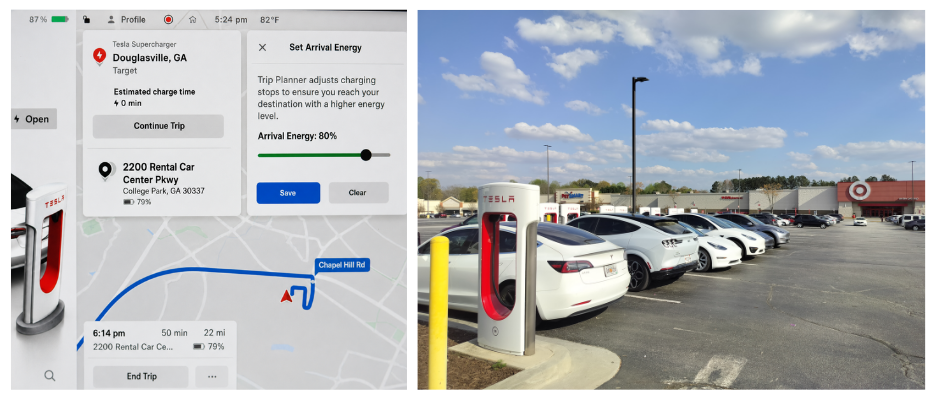
Trip planning was a multi-app experience, bouncing between PlugShare for availability and amenities, Google Maps for regional locations, and the car’s built‑in navigation for compatible fast chargers. Each tool had something to offer, but none was complete on its own, so we had to crosscheck information throughout the trip. Another limitation of the car’s navigation predicting the charging plan was that it would only suggest a single location, based on the selected arrival energy we wanted for our final destination (pictured), which we could change to get other suggested locations. There was the option to choose “best amenities”, and this option assisted us in stopping to charge while eating lunch on the return trip.
Charging a rented car raised additional questions in navigating a brand-specific infrastructure that assumes the driver is the owner of the vehicle. The rental agreement specified that if the rental car were a Tesla, fast charging would automatically charge back to the rental agency, who would add a “reasonable administrative fee.” We were left with specific questions: How high were those rental‑specific fees? Would charges show up right away, or later on the final bill? And while the Tesla App and the car’s built-in navigation would normally be an obvious solution to find and track charging, its limited compatibility with a rental situation, such as requiring a registration address, added another layer of complication. In the end, there were enough obscure fees and charges on the rental car receipt that we are not certain exactly which, if any, were added for refueling at the Superchargers!
Only mildly daunted by the situation described so far, we loaded up for the trip and were ready to depart Atlanta with 88% of the battery capacity. First, we needed to determine if we could get to our destination or if we’d need to stop to charge. After we selected our hotel in Tuscaloosa as the destination, the car’s navigation system selected a charging location near I-20 in a Wal-Mart parking lot in Pell City, AL. Even if the car had a full 250-mile range, we would have chosen to stop en route to charge, given the unfamiliar territory and limited charging options. We aimed to stop around 30% capacity, 120 miles into the 210-mile trip.
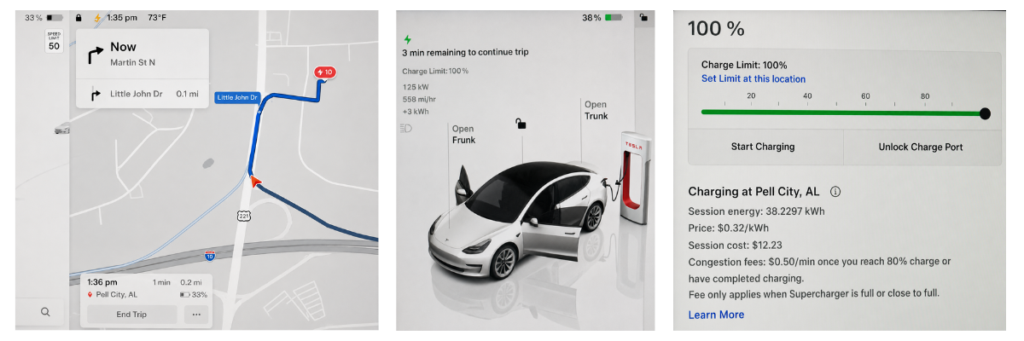
We arrived at the chargers in Pell City and found only two were occupied by other vehicles. At that point the car had 33% battery, so it only took 30 minutes to return to a full charge, adding 38.23 kWh at a cost of $12.23 ($0.32/kWh). At the beginning of the charging session, we observed instantaneous power at 125 kW, more than 10 times the power of most level 2 chargers!
We had enough battery capacity to drive around town while we were there, but stopped fairly soon into the return trip to top off in Vance, AL. We put in 36.93 kWh at a cost of $12.55, and while charging stopped for lunch at Sadie’s Diner off of I-20. It’s important to note that if we were able to charge at the hotel overnight, we could have made the return run with a single charging stop just before returning the vehicle.
After an additional stop in Douglasville, GA, before returning the car, to ensure we were at more than 70% per the rental agreement, total charging for the entire trip was $37.74, a total of 109.3 kWh of “fuel” for the car. The rates varied from $0.32/kWh to $0.38/kWh, though we were able to avoid the congestion fees of an additional $0.50/minute that may apply if all the chargers are full and the car is more than 80% charged (pictured).

Comparison to the alternative: An intermediate SUV at the same rental price was listed with 20-26 mpg fuel economy, since we were mostly on the highway, the 451-mile round trip would have required 17.3 gallons of gasoline, which would cost approximately $63.31. Our total cost for supercharging was $37: almost half the expense! To equal the cost of 8.2 cents/mile in a gasoline car would have required us to complete the trip using only 10.3 gallons of gas, an equivalent fuel economy of 44 mpg (very rare to find in a rental vehicle)! Compared to other electric or hybrid vehicles, going 451 miles on 109.3 kWh was an average of 4.1 miles driven for each kWh.
Downsides: Overnight charging was the biggest missed opportunity. With the right adapter, level‑2 chargers at hotels, homes, or retail locations could have handled most of the charging, particularly with an initial en route fast charge. Instead, the rental situation limited us to needing the faster (and potentially more expensive) options which were not as widely distributed, limiting our options and raising potential range anxiety.
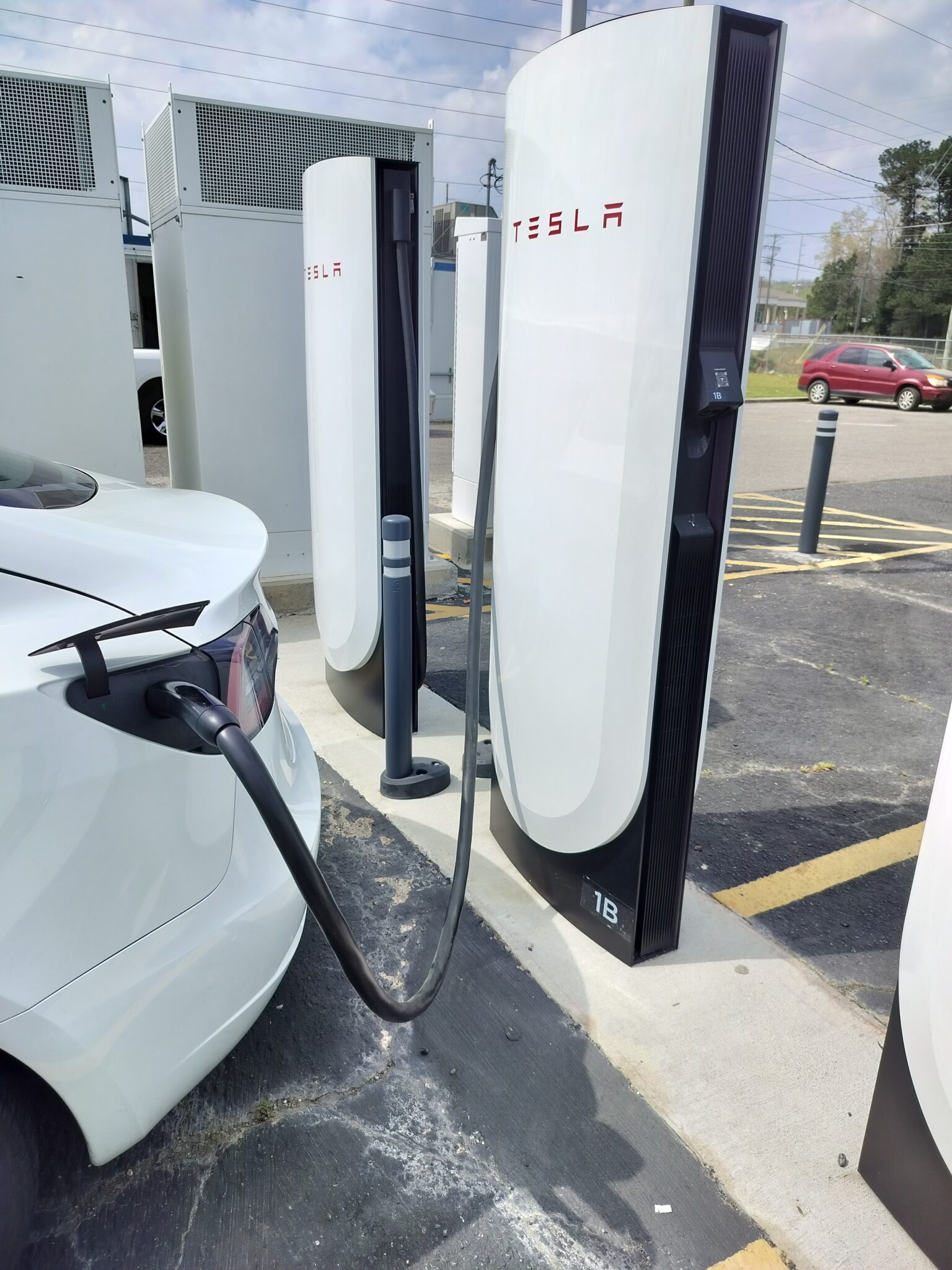
Other downsides included having to learn how to use an unfamiliar system which was primarily controlled on the screen, even for simple tasks like opening the glovebox or operating the windshield wipers or lights. The car eventually turned itself off when the key card was removed from proximity, but we felt more confident navigating the menu to turn it off manually. Depending on the site, the supercharger cable was not able to reach the charging port (pictured), which added some stress when there was only one charger available! While any rental car may have elements that are not familiar, there were certainly more unfamiliar and nonintuitive elements of the Tesla than a gasoline rental car.
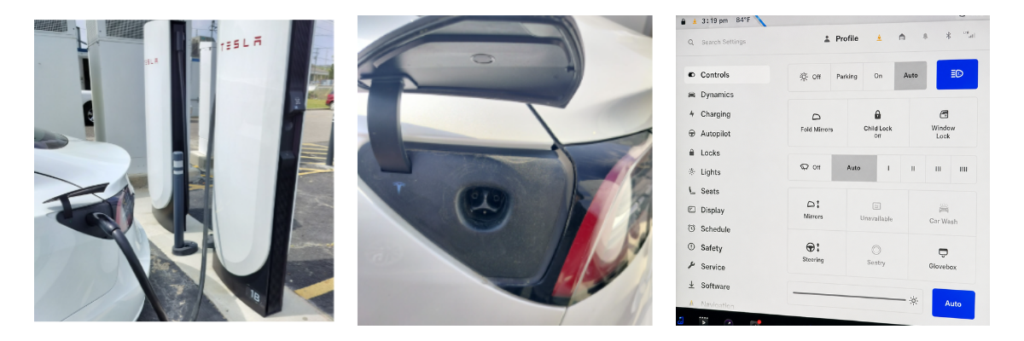
So, would we take another road trip in a rented EV? With this experience under our belt and a better sense of how long fast charging takes, our answer is yes—especially if we know the car’s range and charging options ahead of time.
Several factors come into play when selecting an EV for a rental, including cost, charging availability, and safety while charging. For families weighing their next vehicle purchase, renting a car is a great way to decide which one is right for them. As road trips continue to remain a central part of American life, a fully supported EV rental experience can be an appealing option for consumers.