

Month: September 2026
Op-Ed: Energy Affordability Has an Income Problem, Not Just a Bill Problem
By John Silkey
Executive Director, Southeast Energy Efficiency Alliance (SEEA)
The energy affordability conversation has a blind spot. Household energy bills grab the headlines. But in the Southeast, we have some of the lowest electricity rates in the nation, and the highest energy burdens, even before new manufacturers and data centers arrive.
That’s not a contradiction. It’s a clue: cost is a necessary variable to address, but not sufficient to solve the problem. We need to weigh household income as much as energy costs.
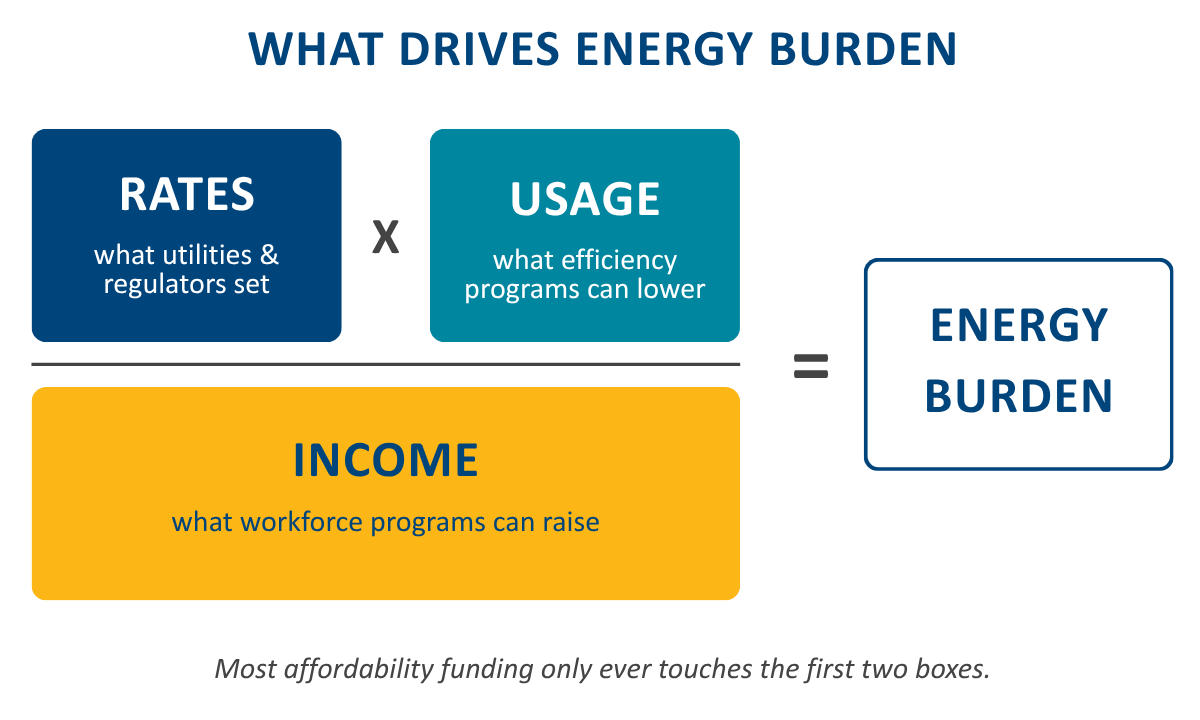
Rates and efficiency are what utilities and regulators control. Income is driven by job opportunity. Most affordability funding touches only the first two variables. A workforce-focused efficiency program touches the one that changes a family’s trajectory.
The Treadmill
Energy is a service no household can do without, and usage can’t be meaningfully reduced without upfront capital most Southeast households don’t have. Utility programs help but hit two hurdles: millions of Southeast homes are too structurally poor to qualify for those programs, and many who do qualify still lack the capital for bigger upgrades like insulation, HVAC, or windows. The 33% who rent have no incentive to invest in something they don’t own.
Affordable rates and utility programs can help prevent shut-offs and predatory payday loans. But they don’t solve what is a long-term problem.
Walk through the affordability funding ecosystem and you’ll find the same logic repeated at every level: reduce the bill. Weatherization budgets. LIHEAP allocations. Utility rebate programs. Each lowers what a household owes each month. None changes what it earns. These programs were never designed to solve a structural income problem.
Here’s what that gap looks like in the numbers:
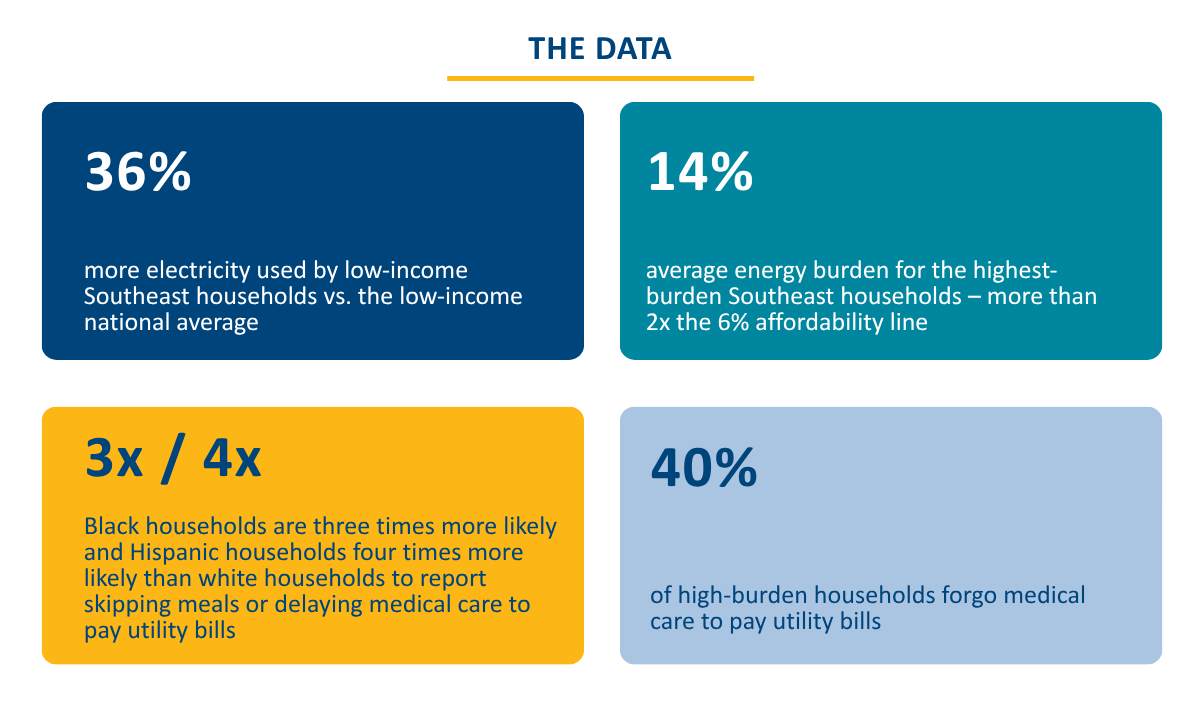
More rebates alone won’t fix this. The treadmill runs faster than support can keep up. And the energy transition provides a generational opportunity for some to get off it.
The Wrong Question
Private funding has largely followed the public sector’s lead, funding programs that help households cope with a structurally broken situation. That made sense when federal programs provided the floor and philanthropic dollars filled the gap.
But the question we’ve been funding, how do we lower the bill, is incomplete. The question we need to ask: why is the bill a burden in the first place? The answer breaks into two parts.
On the consumption side: low-income Southeast households use 36% more electricity than the national low-income average. Their homes are old, leaky, and inefficient. On the income side: Mississippi, South Carolina, Alabama, Georgia and Arkansas rank at the top of the nation in low-income energy burden. They’re not the states with the highest rates. They’re the states with the lowest incomes.
So funding that only touches the bill side isn’t a long-term solution. It’s a maintenance program.
Utilities and regulators are right to focus on rates, reliability, and bill impacts. That’s the system they steward. But affordability is also a function of aging housing stock and regional income, realities outside any one institution’s authority. Paired with rising workforce shortages in the energy trades, that gap is also an opportunity.
A Different Category of Investment
That opportunity starts with people. Millions of experienced trades workers are set to retire in the next four years, a gap clean energy deployment is already running into. SEEA members feel it now in too few energy auditors and higher costs to reach areas where the skilled workforce doesn’t exist. It’s a challenge in both rural and urban centers. The energy transition will require the largest trades hiring wave in generations, and that demand isn’t going away. The workforce to meet it is.
That’s the gap Building Opportunity Labs is built to close. At SEEA, we’re developing a model that turns trusted community buildings and cultural institutions into energy upgrade and workforce training hubs. Residents aged 18 to 25 train to install the technologies that lower energy costs in buildings in their own communities. Fellows earn $18 an hour during training, complete stackable credentials, and move into career-track jobs with SEEA members who are hiring for them.
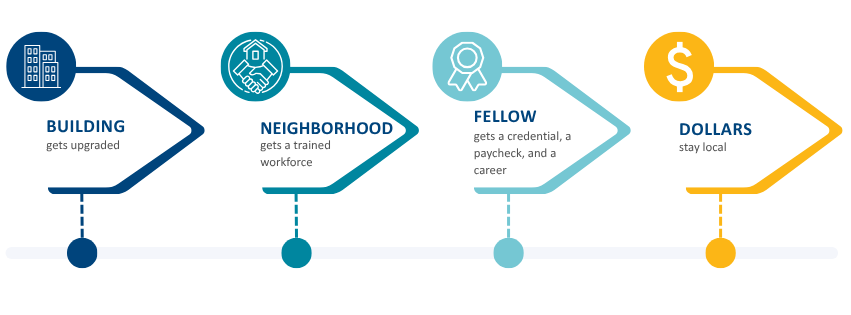
That’s not only an energy efficiency program. It’s an economic development strategy that addresses two-thirds of our equation at once, consumption and income, and it belongs in a workforce and economic mobility portfolio, not just a clean energy one. The energy transition delivers the opportunity; it isn’t the point of the investment.
What a Different Conversation Looks Like
The workforce gap is opening now, and the window to put low-income residents on the right side of it is time-limited. There’s a category of investment that works the income side of the ledger, not just the bill side. It uses the energy system as the engine while still reducing consumption, and it needs funders willing to ask a different question.
Let’s not fund just the treadmill. Let’s fund the ladder.