

Month: August 2026
Where the CDFIs Are: August Map of the Month
By William D. Bryan, Ph.D.
Community development financial institutions (CDFIs) are critical financial lifelines for households that lack access to capital needed to address deferred maintenance and improve the efficiency and long-term affordability of their housing. There are now more than 1,300 certified CDFIs nationwide, with assets that have grown from $47B in 2011 to $446B in 2025, according to research from the Federal Reserve Bank of New York. These funds provide capital to meet a range of critical community needs, from the construction of affordable housing to microloans and even energy efficiency upgrades.
This month, we are taking a deep dive into where CDFI capital is actually flowing across SEEA’s footprint, how it is being deployed, and what role this capital plays in funding building upgrades.
Using U.S. Treasury data from the CDFI Fund’s FY2022 Transaction Level Report (TLR), the most recent data available, we mapped more than 300,000 individual CDFI transactions across our 11-state footprint and then filtered this to 49,000 transactions (about 15% of all transactions) that were intended to fund building improvements, including home repair and rehabilitation and new construction financing. While substantial, this dataset is a subset of all CDFI lending activity because it is only required for recipients of federal CDFI award funding.
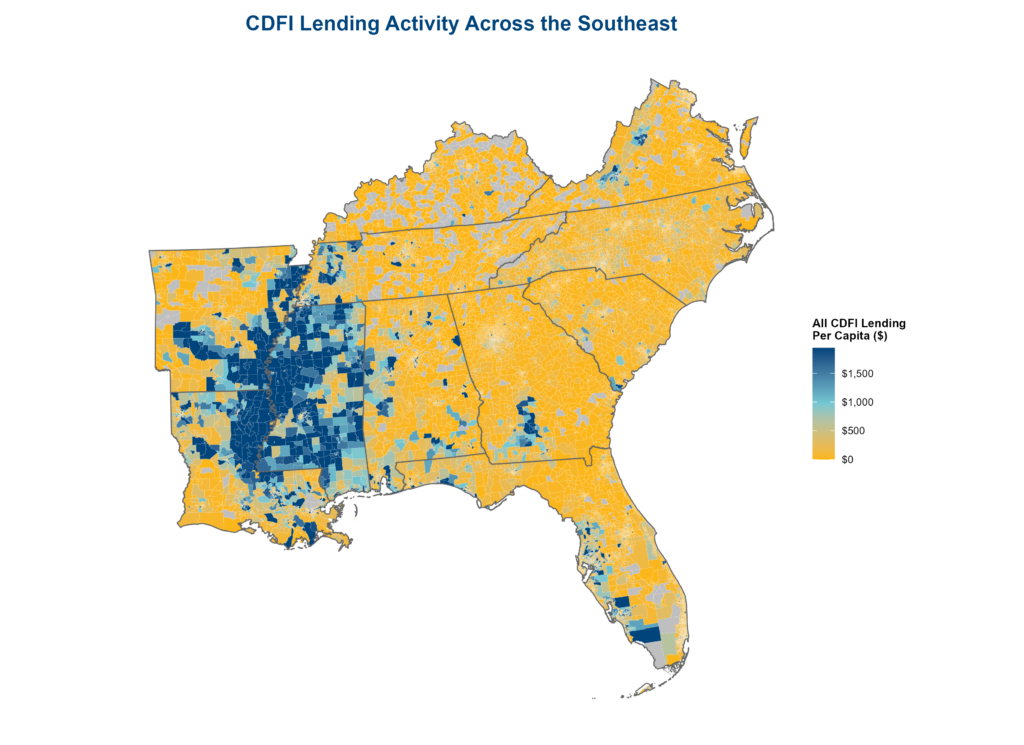
As indicated in Figure 1, overall lending activity per capita was overwhelmingly concentrated in areas surrounding the Mississippi River in Arkansas, Mississippi, and Louisiana—the region where there is a high concentration of local CDFIs, according to the Federal Reserve Bank of New York. Across the entire region, microloans (66% of all transactions) to small businesses and home purchase loans (11% of all transactions) were the most common types of lending. The CDFI portfolio overall represents a critical injection of more than $30.2B, just in FY22, to communities throughout the South that often lack access to traditional financing and capital.
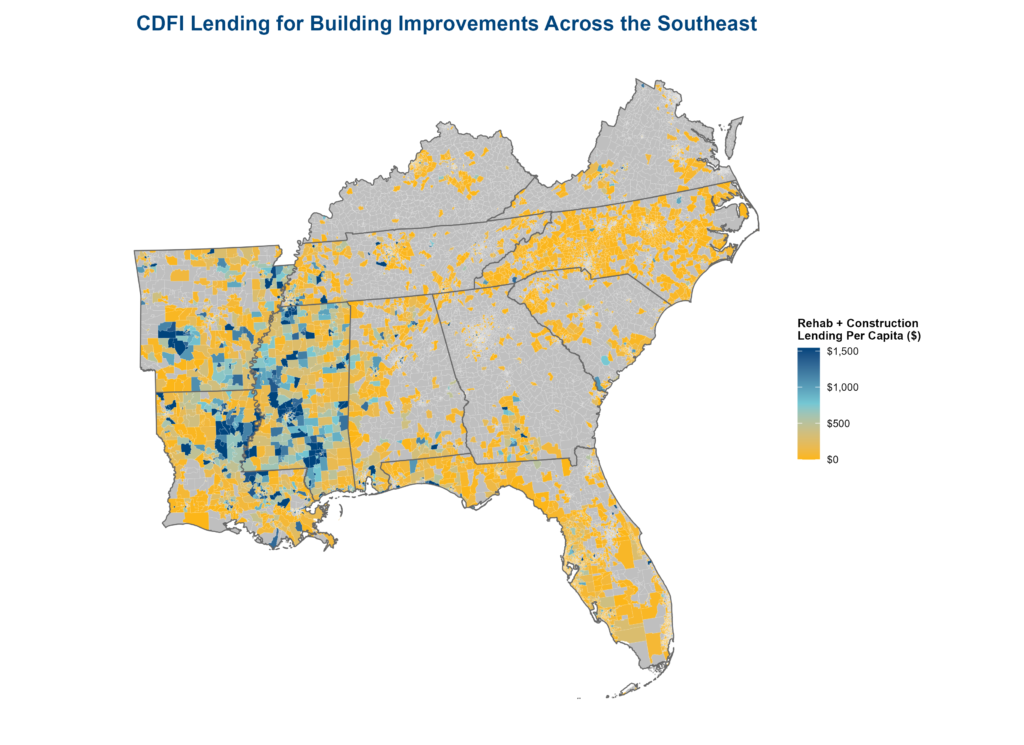
But CDFIs also play a critical role in providing access to capital that can help households address deferred maintenance and address efficiency drags on their home. Lending to support home upgrades made up around 15% of total transactions in the Southeast, but a much larger share of total dollars—more than one third (37%) of all capital deployed across the region, totaling $11.1B in FY22, as indicated in Figure 2. New construction financing ($6.7B) exceeded rehab and home improvement lending ($4.4B) overall, even though rehab and home improvement loans made up nearly three times as many individual transactions.
This type of lending is critically important. For many households, CDFI capital is often the only avenue for fixing a damaged roof, providing a safer electrical system, or installing a more efficient HVAC system—the kind of work that determines whether their home will be affordable to maintain and operate in the future. Geographically, the lending patterns are similar to the overall lending picture, in exaggerated fashion, with the Arkansas and Mississippi Delta region leading the Southeast in terms of lending per capita. By contrast, Georgia and Kentucky have modest rehabilitation and home improvement financing (about $120M and $59M respectively in FY22) despite both states having deep housing needs.
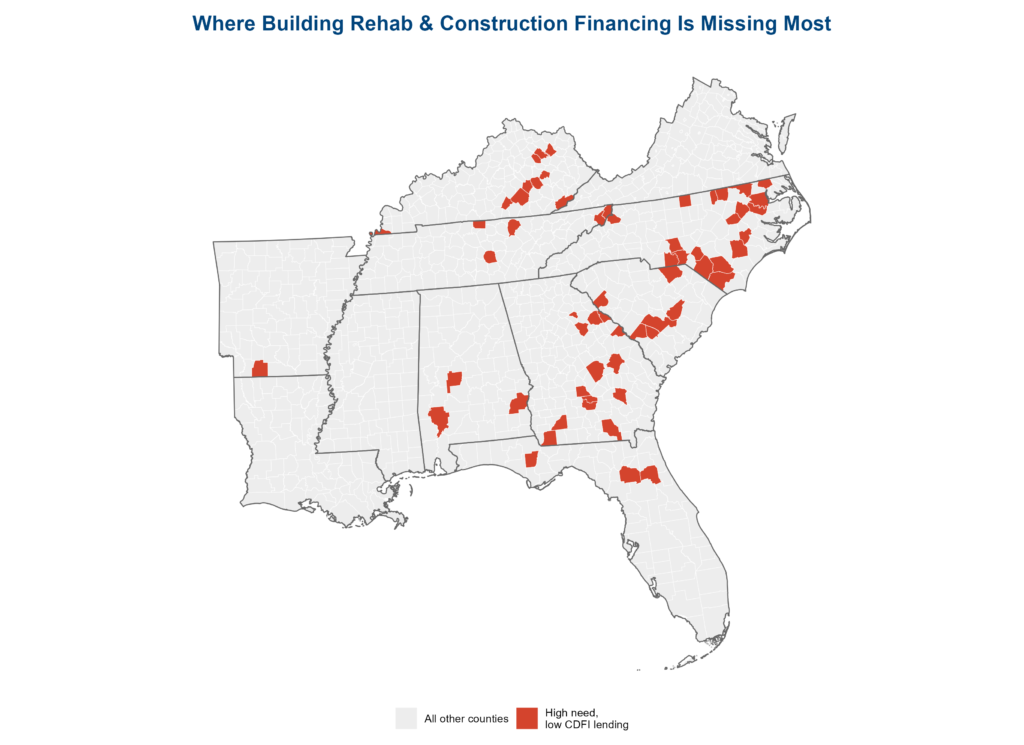
Figure 3 shows the lending gaps, isolating just the places where need is high (specifically, high poverty rates) and lending per capita is low compared to the rest of the Southeast. At the county level, the highest concentration of underserved counties is in North Carolina and South Carolina, with localized capital gaps in Alabama, Georgia, Kentucky, and Virginia.
Taken together, this data highlights the essential services that CDFIs play in providing access to billions in capital for a wide range of needs across the South’s most underserved communities. Yet this capital is unevenly distributed in ways that make it unable to fully meet the region’s critical housing needs. While lenders are doing heavy lifting work in some of the most under-resourced communities in the South, like the Delta, in other high-need areas this concentrated approach has not been deployed with the same kind of scale.
Across several recent projects—including SEEA’s SEEDS initiative—SEEA has been working to meaningfully develop pathways to improve access to capital for deferred maintenance and home upgrades. We see financing as the critical piece of the puzzle for improving household efficiency at scale for low-income residents, who often lack access to the capital needed to invest in expensive home upgrades. The data outlined here underscores that CDFI capital is a critical tool for bridging affordability and efficiency needs, underwriting billions of dollars of home upgrades already. Yet this data also provides a roadmap for closing critical service gaps to ensure that this capital continues to create community transformation across the Southeast.