

OpEd: The cheapest power plant in the Southeast is already built.
By John Silkey
My house was built in 1952 and renovated in 2021. New systems, new windows, new finishes (with a tired, generic farmhouse aesthetic – but that’s a story for another time.)
It still hemorrhages cold air in the summer and warm air in the winter. My energy bills show it every month. We did not skip maintenance – biannual HVAC tune ups, vent cleaning, weather stripping. A utility in home audit showed the house was meeting much of their standards with a few, expensive exceptions. The house still leaks.
The power company could build thirty more power plants. It would not fix what is wrong with my house. In fact, my bill would go up, because I would be paying for the construction of those plants and the fuel to run them, on top of the energy I am already wasting.
My house is not an outlier. Across the Southeast, roughly 40 percent of homes were built before 1980, before most of the region had any energy code at all. Conversely, despite our construction boom, less than 30% of southeastern homes were built after 2000. We have tens of millions of houses leaking energy every single day, in every single county, and every one of those leaks shows up as a charge on a customer’s bill and a megawatt added to a utility’s forecast.
I’m fortunate that I can financially handle this waste. Millions more in the Southeast are forced to decide between paying their power bill or their medical costs or their car payment.
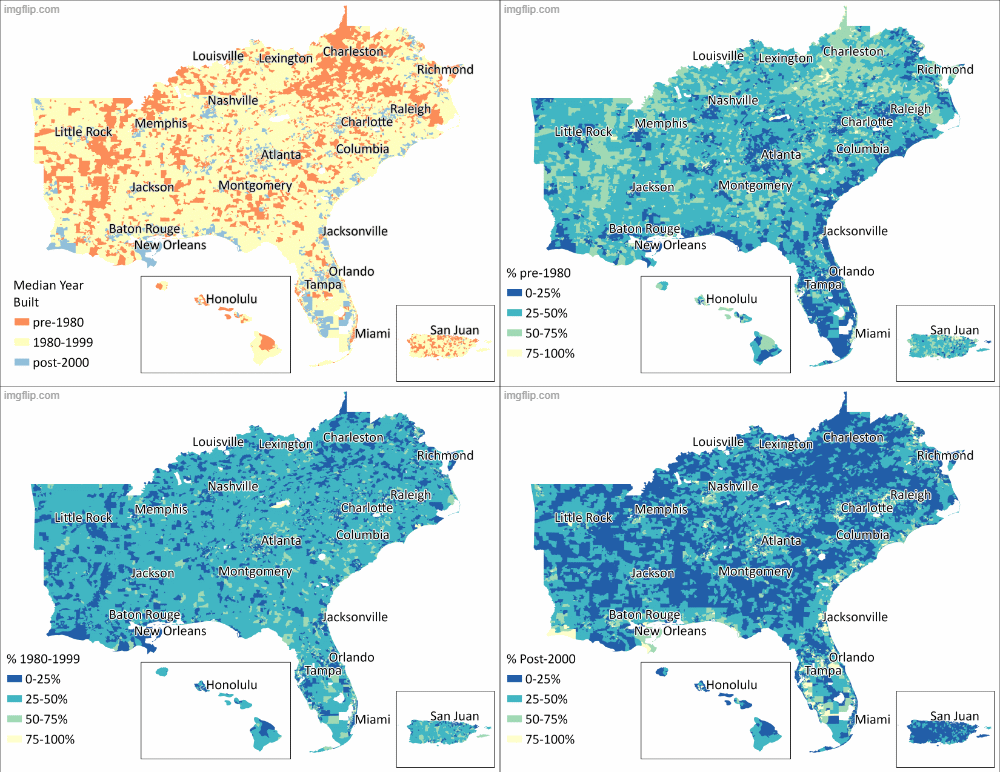
A map from SEEA illustrates the age of housing across the Southeast, including the percentage of homes built during different time periods and the median year of construction. The census tract-level analysis represents approximately 40 million homes across the region and is based on data from the U.S. Census Bureau’s 2023 American Community Survey (ACS).
For the first time since the 1970s, energy costs are back at the kitchen table conversation. Bills are rising. We have the fastest projected load growth the Southeast has seen in decades. And the response, from policymakers and much of the funding world alike, is to focus on what we can build. More generation. More transmission. More clean power before the tax credits disappear.
All of that is necessary. None of it fixes these homes and the massive drain of electrons spinning away underutilized. None of it changes the fact that we keep reaching for the expensive solution when a cheaper one is sitting right there, underfunded, in plain sight.
Here is the part of the equation that keeps getting left out.
Energy waste is not just an inconvenience. It is a cost driver, and the cost lands on everyone, not just the household with the drafty windows. When a building leaks energy, something has to make up for what it loses. That something is generation. Utility customers fund all of it. They pay to build the plants. They pay to fuel them. Every kilowatt wasted is a kilowatt that has to be generated, delivered, and billed, to every customer on the system, not just the one with the leak.
One kilowatt saved costs utilities less than $40 per year to deliver, according to ACEEE. One kilowatt of new generation costs more than $51 per year to build. A comprehensive efficiency upgrade, the kind my house still needs, can cut annual energy costs by 10 to 30 percent. Multiply that across 40 percent of the homes in the Southeast, and the math stops being about one homeowner’s bill. It becomes a regional capacity question, right as new power demand is pushing that capacity to its limit.
Some southeastern utilities already understand this. When they do long-term resource planning, projected efficiency savings come off the top of expected demand before they calculate how much new generation to build. They are not doing this to be good environmental citizens. They are doing it because it is cheaper than the alternative. A region full of homes like mine forces the grid to overbuild. A region of sealed, updated homes does not.
Meanwhile, federal lawmakers are cutting weatherization funding and LIHEAP, calling them government waste. They are not waste. They are investments that reduce the load every customer on the grid pays to serve. Cutting them does not save money. It defers the cost into the next rate case and hands the bill to the same customers these cuts claim to protect.
Clean generation funding is visible. A solar array is something you can photograph and point to at a board meeting. Efficiency is invisible by design. It is the energy that was never wasted, the plant that was never built, the bill that never arrived. Nobody cuts a ribbon for a sealed attic.
That invisibility is why it stays underfunded, and why philanthropy has a huge opportunity here.
Efficiency upgrades work faster and cheaper than almost anything else available, including solar, wind and battery. Demand-side resources can be deployed in under six months. A new gas peaker plant takes five to seven years to permit and build. Community solar takes at least 2-3 years. The Southeast does not have years to wait. The need for more power is growing now, and so are the bills of every homeowner whose house was built before anyone thought to ask how much energy it would waste.
Funding new generation without funding efficiency is like putting a new furnace in a drafty house and calling the problem solved. The furnace runs all day. The house is still cold. The bill is still high.
My house needs both. So does this region. Close the drain, and every dollar already being invested in clean generation will go twice as far.