

Month: March 2026
March Map of the Month
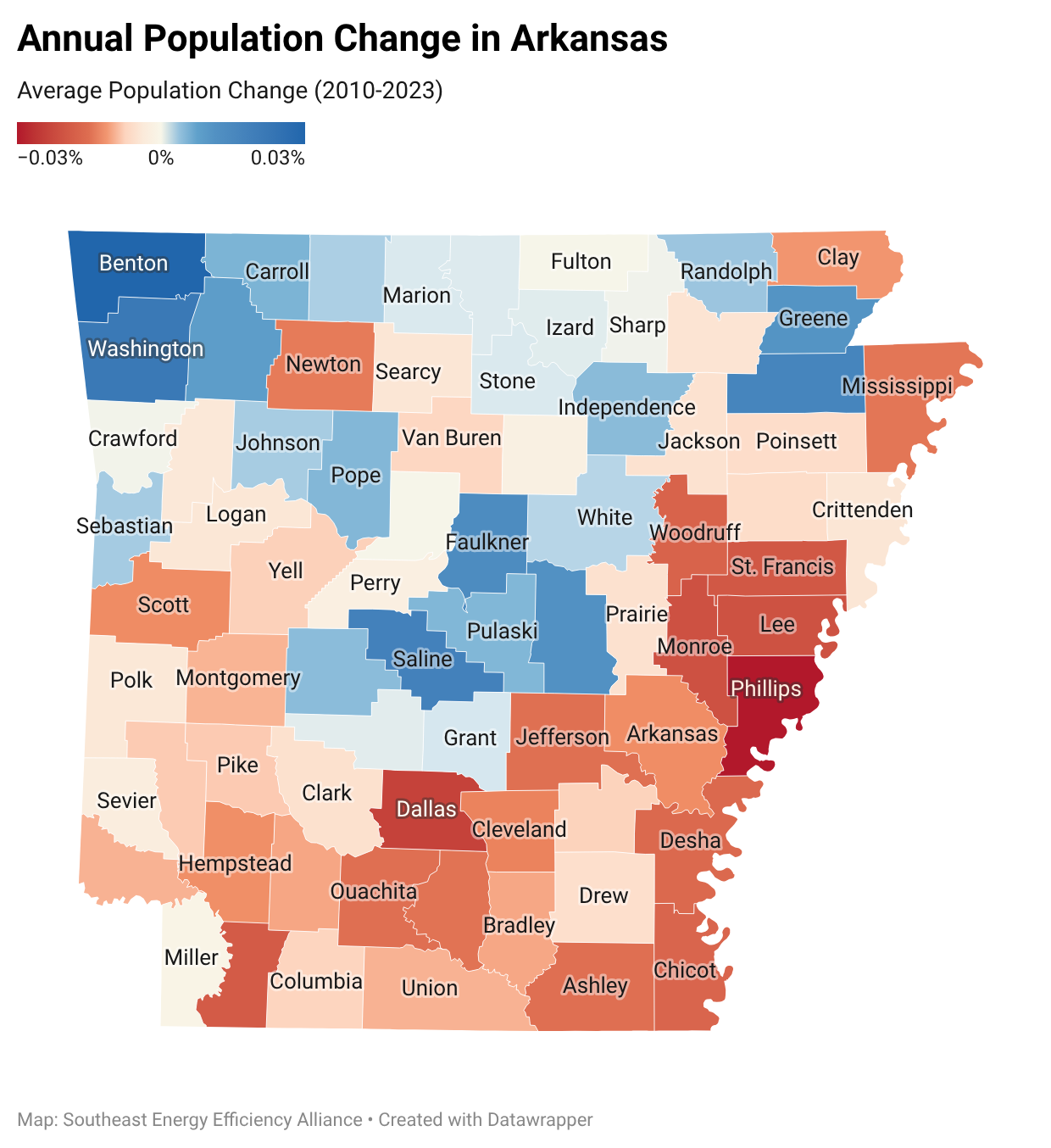
Growth and Energy Burden in Arkansas: A County Comparison
By Laura Diaz-Villaquiran
Data: U.S. Census Bureau ACS (2020–2024); U.S. Energy Information Administration (EIA); U.S. Department of Energy LEAD Tool
Across Arkansas, patterns of population change and energy burden are closely connected. The state consumes nearly 60% more energy than it produces, and while its electricity prices are among the ten lowest nationally, affordability varies widely depending on income, housing quality, and local economic conditions. For many low-to-moderate income households, energy costs still represent a significant share of monthly expenses.
This analysis examines how population change intersects with energy burden statewide. Communities experiencing growth generally benefit from newer housing stock, active labor markets, and expanded economic opportunity factors associated with lower energy costs relative to income. Declining communities, by contrast, often contend with shrinking economies, aging and inefficient housing, and elevated energy burdens that compound existing hardship.
A Tale of Two Counties:
In Arkansas, Benton County and Phillips County illustrate these differences. Benton County, located in northwest Arkansas, has experienced sustained growth, with a population increase of 17% between 2020 and 2025. This growth is supported by a strong labor market, with employment increasing by 7.1% between 2022 and 2023, and significant residential development, with 4,453 building permits issued in 2024.
Benton County also has a more diverse population, with 12.7% foreign-born residents and 15.8% of households speaking a language other than English at home. In Benton, the median household income is $93,506. Homeownership is relatively high at 67%, and 94.4% of households have broadband access. Median monthly housing costs include $1,717 for owners with a mortgage and $1,277 for renters.
Phillips County, located in the Mississippi Delta, presents a different picture. The county experienced a population decline of 13.7% over the same period, alongside a 5.2% decline in employment between 2022 and 2023 and only 16 building permits issued in 2024.
Phillips County is 61.8% Black, 34.5% White, and 2.5% Hispanic or Latino, with a much smaller foreign-born population than Benton County (1.5%).
In Phillips County, the median household income is $40,134, and 35.8% of residents live in poverty, over four times the rate of Benton County.
Homeownership stands at 51.2%, and 79.3% of households have broadband access. The median gross rent in Phillips is $737, reflecting lower housing costs but also lower incomes and limited economic opportunity for its residents.
Energy costs represent a disproportionately large share of income for Phillips County residents. Low-to-moderate-income households carry an average energy burden of approximately 12%, double that of Benton County. Energy poverty researchers define energy burdens of 6% to be high and burdens above 10% severe.
These differences underscore deep regional disparities in the Arkansas–Mississippi Delta, where counties such as Ashley, Chicot, Lee, and Mississippi experience a compounding cycle of population loss, elevated poverty, and severe energy burdens.
SEEA’s work focuses on these regional differences by bringing together cross-sector partners to align data, programs, and policy. Insights like these help target energy efficiency investments, inform workforce development strategies, and support solutions that improve affordability and resilience. By connecting data to action, this approach supports more consistent and measurable progress across communities in the Southeast.